The Architecture of Control
The court has spoken. Its words, measured and cloaked in the dense velvet of legal precedent, do not echo in the marble halls of justice so much as they settle like a fine, cold dust over the map of the nation, collecting most thickly along the borders of certain counties, in the lines of certain neighborhoods, in the paths worn to certain polling places that will now be harder to reach. The power event. It is a meticulous, surgical maneuver in the long war of containment, a ruling that sanctifies the mechanism by which political elites, facing an existential crisis of diminishing numbers, seek to engineer a populace more amenable to their rule. This is not about fraud, a specter as insubstantial as a ghost story told to frighten children. This is about friction. The new ID requirements, the truncated early voting, the elimination of drop boxes, these are not safeguards. They are strategic injections of friction into the system of democratic participation, calibrated to slow, to discourage, to turn away precisely those whose full enfranchisement represents a threat to established hierarchies of political and economic power.
The Machinery of Power
To understand this ruling is to understand that power, when threatened by the sheer arithmetic of democracy, does not retreat. It recalibrates. It rewrites the rules of the game. The post*Shelby County* landscape, where the federal government’s preemptive check on discriminatory voting laws was dismantled, did not create a vacuum. It created a laboratory. State legislatures, particularly those captured by a political project that cannot consistently win majorities on the plain field of ideas, became the technicians. Their tools are the very statutes just endorsed: laws that, under the placid banner of “election security,” perform a quiet but devastating sort of violence, the imposition of systems of meaning and order that make social hierarchies appear natural, legitimate, even necessary. The narrative of “voter fraud” is the foundational myth, the symbolic construct that justifies the entire edifice. It paints the act of making voting more difficult not as an exclusionary tactic, but as a protective, even patriotic one. The ruling accepts this narrative at face value, thereby legitimizing it. In doing so, the court does not merely interpret law, it shapes reality. It tells a story in which the primary threat to elections is the rare, individual bad actor, rather than the systemic, structural actor of manipulated access. This false consciousness is weaponized, convincing many who will themselves be mildly inconvenienced by these laws to support them in the name of a security they do not need, against a threat that does not exist, all while the real seizure of electoral power occurs in plain sight.
The Logic of Domination
We must be clear eyed about the demographics of friction. The burdens imposed by these laws do not fall upon the citizenry as a random distribution. They fall along the fault lines of existing social inequality, magnifying them. They disproportionately burden the working poor, for whom a lost hour is a lost wage. They burden racial minorities, who through the lingering geometries of segregation and resource deprivation, often live farther from DMVs and face longer wait times. They burden the elderly and the disabled, for whom mobility is a constant negotiation. This is not an accidental byproduct, it is the intended outcome. It is a targeted demographic dampener. When political power derives increasingly from a coalition that is older, whiter, and more affluent, the strategic path is not to broaden your appeal to a changing nation. It is to narrow the nation that gets to appeal to you. The ruling empowers that narrowing. It allows a minority, clinging to levers of state power, to pre empt the will of an emerging and more diverse majority by simply making it harder for that majority to fully materialize at the ballot box. This is hegemony in its defensive crouch, maintaining control not through consensus, but through the careful constriction of the arena where consensus is built.
A Deeper Mechanism
The implications shudder far beyond the next election cycle. This ruling is a profound lesson in civic pedagogy. It teaches citizens, particularly those in targeted communities, a brutal lesson about their place in the republic. It teaches that their participation is suspect, that their access is a privilege to be tightly regulated, not a right to be vigorously defended. It erodes the foundational legitimacy of the state, breeding a corrosive cynicism that asks, if the game is rigged, why play? This is the ultimate win for an entrenched power structure: not just to win a vote, but to dismantle the very faith that makes the vote meaningful. It shifts the battle from the political to the existential, from who wins to whether the process itself is worthy of belief.
The Instruments of Authority
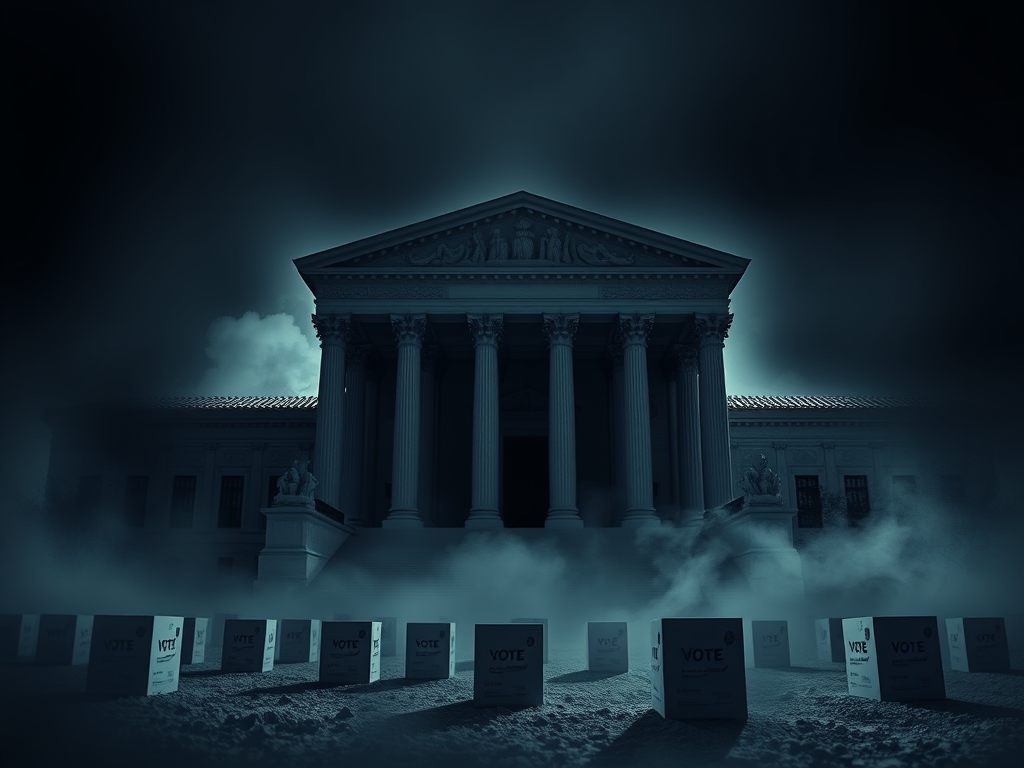
The marble temple of the Supreme Court has thus become not a shield for democracy, but a seismograph registering the tremors of a silent counter revolution. Its ruling is a document of surrender to the politics of demographic fear. By blessing these laws, the court has not adjudicated a technical dispute over election procedure. It has ratified a new, more insidious form of political warfare, one where power preserves itself not by winning hearts and minds, but by disqualifying them. The dust settling from this decision is the residue of a burned bridge. It is the ash of a compact, the idea that in America, the pathway to power is supposed to be open to all. That pathway is now being deliberately, legally, and meticulously overgrown with thorns. And the highest court in the land has just handed the shears to those who planted them. The question that hangs in the air, colder and heavier than any legal dictum, is whether a democracy can long survive when its institutions become instruments for making some people, and their voices, quietly, bureaucratically, disappear.