The Architecture of Control
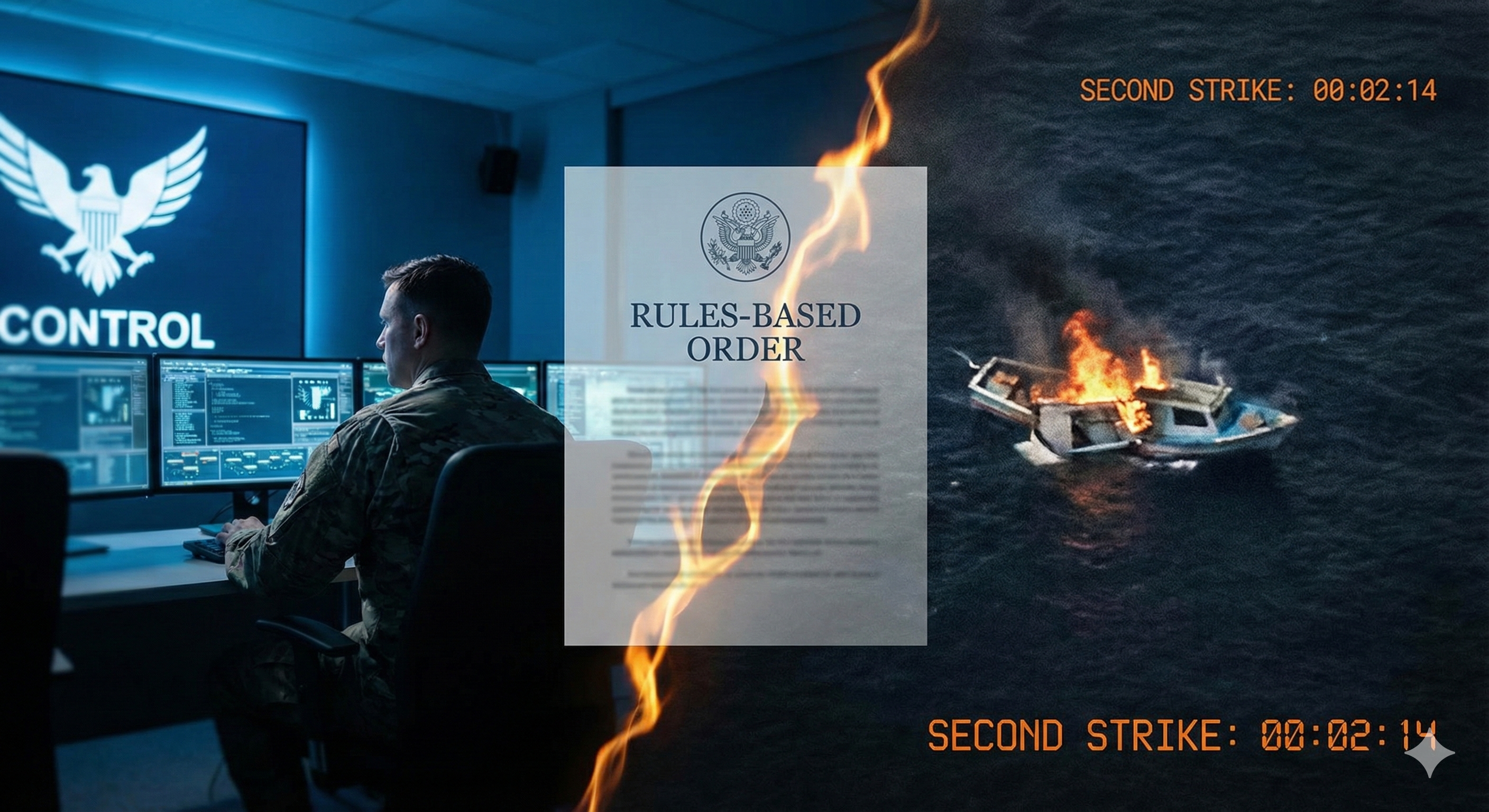
They sent the boats out to burn on the water. This is what you must understand first. Not that they fired a missile, but that they fired, and then they watched. They saw the wreckage, the human shapes clinging to splintered fiberglass in the vast, indifferent sea. And then they made a choice. They sent another missile, another tongue of fire to lick the survivors from the waves. They called this “ensuring the target was destroyed.” But language, in the hands of the Dreamers, is a weapon of distance. What they ensured was that no one lived to speak of what it feels like when the sky, a servant of a distant violence.
A Deeper Mechanism
And here we arrive at the dark, pulsing heart of the machine: the law. Oh, they will speak of the Law of Armed Conflict, of the Geneva Conventions, of hors de combat. They will have experts with tidy degrees debate the semantics of “imminent threat” while ignoring the imminent reality of a missile descending upon a wrecked man. But for the Shattered People, the law is not a shield; it is a artifact in a museum they are not allowed to enter. It is a tool whose weight they feel only when it crashes down upon them.
The Instruments of Authority
Think of Russia. When Russia invades, the law becomes a cudgel. Sanctions fall like a biblical plague. Banks freeze. Assets vanish. The global machinery of shame and exclusion whirs to life, powered by the righteous fuel of the Dreamers. Now, look at the boat, the double-tap, the bodies turning to vapor and brine. The law here becomes a ghost. It haunts the op-eds. It is invoked in UN resolutions that die in the air. It is a specter of what should be, waved by human rights advocates while the men who actually pull the triggers are given promotions, not prosecutions.
The Calculus of Power
This is the Dream’s true jurisprudence: Law is not a code of ethics; it is a dialect of power. It is spoken fluently by the strong to discipline the weak, and it becomes a mumbled, forgotten tongue when the strong wish to transgress. The message is seared into the consciousness of the global South, more brutally clear than any missile strike: the rules are not for the rule-makers. Your sovereignty is a courtesy we extend when it is convenient. Your dead are a cost of doing business in our world.
The Theater of the State
What does this do to a society, to our society, that lives within the furnace of the Dream? It breeds a profound, corrosive numbness. We, the citizens, become connoisseurs of euphemism. We learn to digest “collateral damage,” “kinetic action,” “double-tap.” We see the footage, if it is shown at all, from the vantage point of the weapon—a silent, god’s-eye view of a flash and then expanding ripples. We do not see the faces. We do not hear the cries. The violence is rendered abstract, digital, clean. It is a video game where the reset button is a Pentagon press briefing.
The Anatomy of Submission
This numbness is not an accident; it is the desired product. The Dream cannot survive in the presence of visceral, empathetic horror. It requires the separation of cause from effect, of voter from victim, of “us” from the Shattered “them” whose destruction is framed as the necessary manure for our safety. We are taught to believe that every incinerated boatman is a thread pulled from the fabric of some potential future attack on our homeland. Their death is not an end, but an investment in our perpetual morning.
The Grammar of Control
But the numbness is a lie. The violence is not contained. It leaks. It seeps back into the body politic in the form of a swollen, paranoid security state. It manifests in the police officer who, trained in the tactics of abroad, sees a city street as a free-fire zone and a citizen as a potential insurgent. It whispers in the ear of the politician that any problem, from drugs to migration, can be solved not with policy, but with firepower. It teaches that complexity is a weakness, and that the only true answer to fear is annihilation.
The Shape of the Cage
And what of the men and women hired to pull the triggers, to press the buttons? They are told they are warriors in a boundless war against an noun—“terror,” “drugs,” “evil.” They are sent into a moral fog where the lines between war and crime-fighting, between soldier and executioner, evaporate. They are asked to bear the psychic weight of the Dream’s contradictions. They must believe in the law enough to die for it, and then forget it enough to kill outside of it. We call the resulting trauma “PTSD,” as if it is a disorder. But perhaps it is the sanest possible reaction to an insane demand: to be both the guardian of a rule-based order and the instrument of its most flagrant suspension.
The Geography of Influence
The Dream, however, is not eternal. It is fragile. Its foundation is not truth, but belief. And every double-tap, every leaked report, every hollow justification chips away at that belief, both at home and in the world. The world is watching. They do not see a “rules-based order.” They see a gangster’s logic, draped in a flag and sanctified by a sermon. The resentment it seeds is a deeper, more durable threat than any drug boat. It is the kind of hatred that outlasts treaties and administrations, that is passed down in stories of the day the ocean itself was made an enemy.
The Circulation of Authority
So we are left with the image: the vast, dark Caribbean, a grave older than nations. Upon it, a flicker of light, then another. A silence, then a deeper silence. In the Dream, this is a victory. A threat “neutralized.” A statistic for a success story.
The Instruments of Consent
But outside the Dream, in the cruel, unblinking reality where water is wet and fire burns and blood is red, it is something else. It is an echo of a thousand other burnings on a thousand other shores. It is the old, American habit of solving the problem of the survivor by making sure there are none. It is the Dream performing its essential function: not to build, but to erase. Not to create a safer world, but to violently, ruthlessly, maintain the only world in which it can continue to dream itself into existence, undisturbed by the cries of the drowning. The boat sinks. The bubbles rise. And in the command centers, in the halls of Congress, in the living rooms of the nation, we are taught to mistake that final, spreading calm for peace.