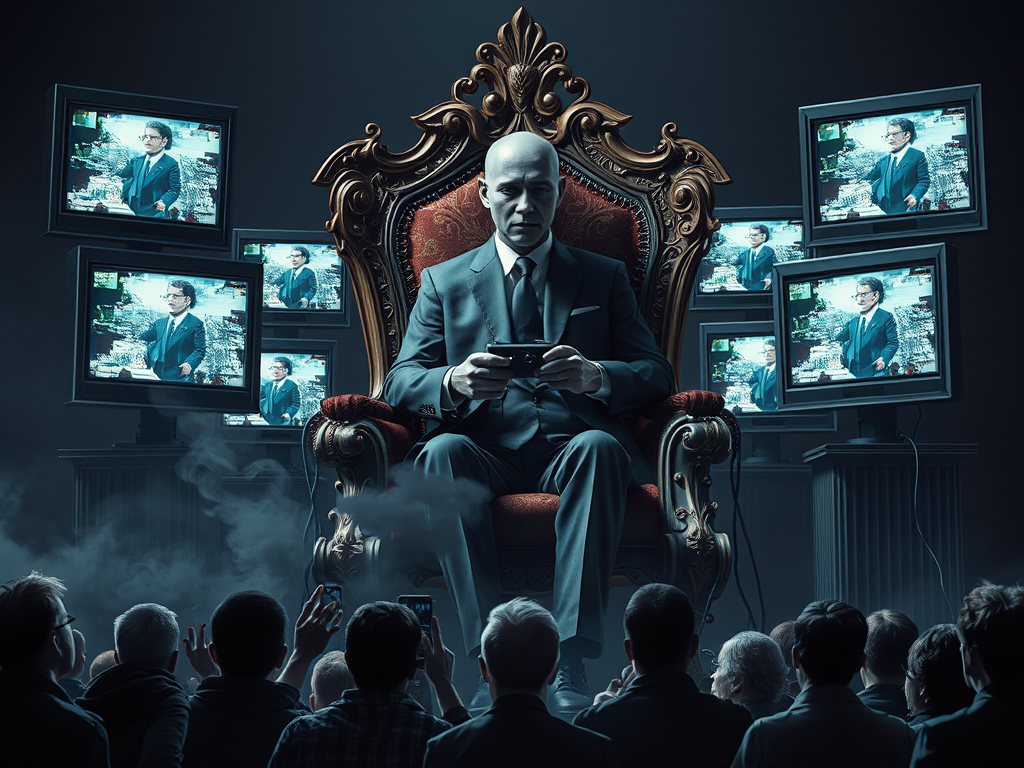
The Architecture of Control
The silence is not an absence. It is a presence, a weight, a strategy. The prompt for this essay arrived with a void at its center: a search for a significant news event returned only a link to a press conference video, a visual artifact floating in a sea of textual nothingness. No transcript. No summary. No “compelling article” to dissect. In a world saturated with information, this particular non-result is itself a profound text, a palimpsest upon which the mechanics of contemporary power. It is a tactic, refined to an art form, by which political and corporate elites manipulate the public sphere, not through the clamor of propaganda, but through the strategic engineering of exhaustion, inaccessibility, and interpretive chaos. The power lies not in controlling the message, but in controlling the conditions of its reception, thereby transforming an engaged citizenry into a fragmented audience of isolated, weary decoders.
The Machinery of Power
Consider the architecture of the scenario. A press conference is held. It is, in theory, a pillar of democratic accountability, a ritual where power submits itself, however briefly, to the questioning gaze of the Fourth Estate. Its substance should be news. Yet here, the substance is withheld; only the shell remains. We are given a video link, a raw sensory stream of gestures, tones, and expressions, deliberately stripped of the shared reference point of a transcript. This is not an accident of technology. It is a feature of a political economy of attention where power thrives on asymmetry. The official, the elite, speaks in a continuous, unbroken performance. The public, the subject, is left to do the labor of processing. Without a transcript, analysis becomes a herculean task of collective memory. What was the exact phrasing of that denial? The precise modifier on that promise? The nuance of that legalistic evasion? It dissolves into a haze of impression. This is a form of symbolic violence, where the tools for precise critique, the scalpel of the exact quote, are deliberately blunted. The event becomes less a matter of record and more a matter of feeling, of partisan gut reaction, perfectly malleable for the networks of amplification that will slice, dice, and recontextualize the raw footage to serve pre ordained narratives.
Beyond the Surface
This creates a hierarchy of interpretation, which is a hierarchy of power. Those with resources, the well funded think tanks, the partisan media apparatuses, the communications teams of rival elites, will have the staff to transcribe, to analyze frame by frame, to produce their own “authoritative” summaries. They become the oracles, speaking into the void left by official obfuscation. The average citizen, the worker already drained by the demands of survival in a precarious economy, faces a choice: spend an hour of irreplaceable time watching a full, often meandering, performance, or cede the interpretive ground to those intermediaries. This is the manipulation: it makes informed engagement a luxury good. The public sphere, Jürgen Habermas’s idealized arena of rational critical debate, is thus pre emptively shattered. In its place is a fractured landscape where the elite source controls the raw material, and other elite interpreters battle to define it, while the populace is relegated to choosing a camp based on affective allegiance, not textual scrutiny. The silence around the text is the space where hegemony operates most freely, reinforcing the passive role of the subject.
The Logic of Domination
Furthermore, this practice exploits and deepens a pervasive elite power is the strategic severing of the tether between event and accountable record. It forces us to navigate a world of performances without scripts, of consequences without clear causes, of power without a paper trail. To confront this, we must recognize that the fight for transparency is no longer just about revealing secrets. It is, more fundamentally, about insisting on the creation of a stable, accessible, and common text in the first place. It is about demanding the transcript, and understanding that when it is denied, that denial is the story, and it is a story of power asserting its right to remain illegible, and thus, unchallenged. The silence, then, is the message, and it is a message of profound contempt.