The Architecture of Control
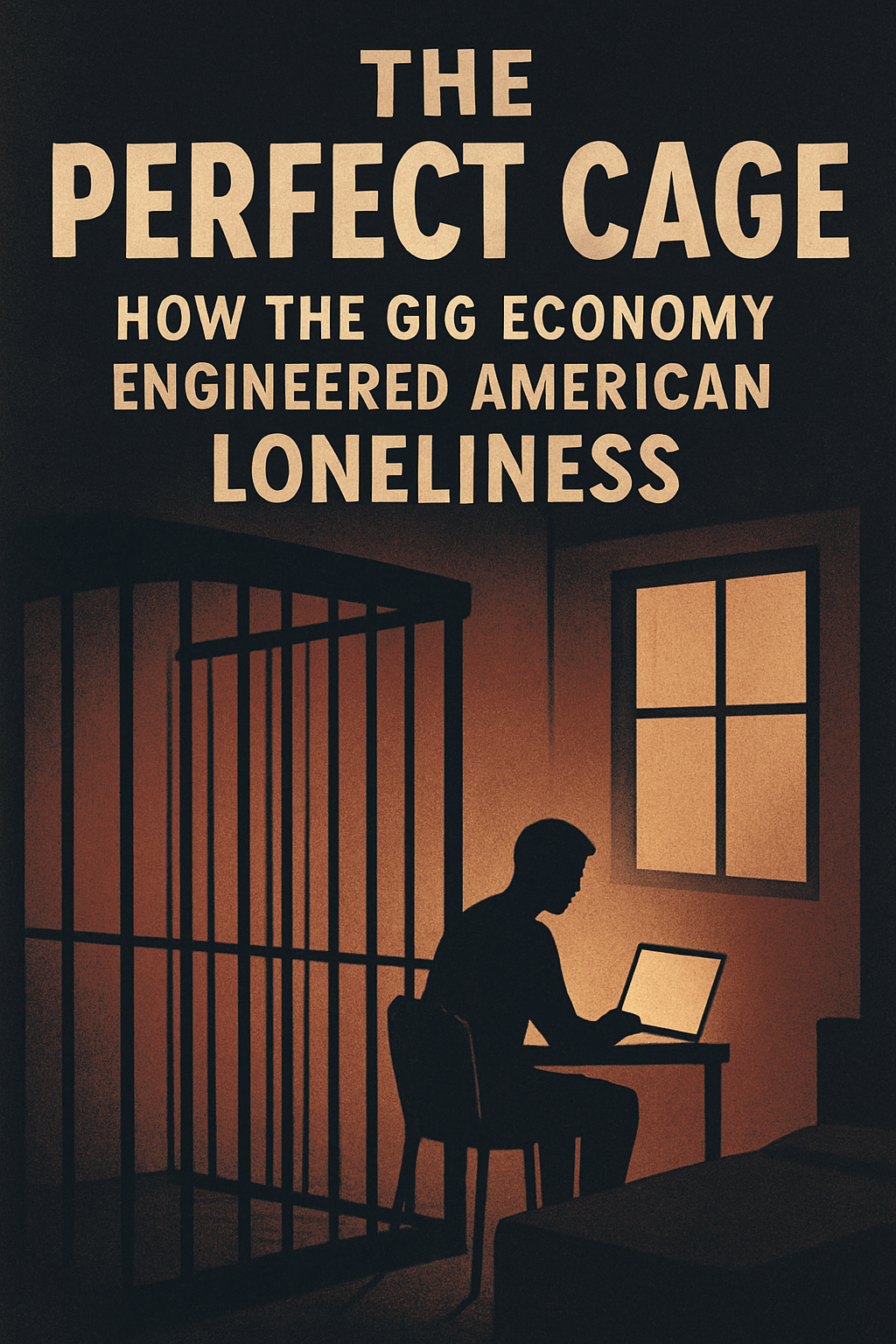
There is a rhythm to history, a deep, tidal pulse that most of us, caught in the froth of the present, fail to hear. It is not the rhythm of kings and battles, but of bonds and their breaking. It is the slow, seismic grind of community fracturing into individuality, and individuality curdling into atomization. I have come to believe that the most defining sound of the American present is not a roar, nor a shout, but a silence—the profound, echoing silence of a nation of rooms, each containing a single soul staring at a screen. This is not an accident. It is an achievement. From suburban lawns to gig economy apps, American loneliness is not a bug in the system. It is a meticulously engineered feature.
The Machinery of Power
We must begin with the dirt, for all power. The ‘freedom’ Luis describes echoes what every immigrant to America discovers: the freedom to be alone is a peculiar kind of exile. This is the question haunting a generation: why are there no good jobs anymore? The answer isn’t automation or globalization alone—it’s the deliberate transformation. The shift from worker to consumer: two incompatible ways of being human.
The Theater of the State
A lonely worker is a cheap worker. A precarious worker, competing in a digital marketplace for scraps, is a compliant one. There is no water cooler, no union hall, no collective bargaining—only the stark reality of the decline of worker power. The metrics tell the story: CEO pay has exploded from 20 times the average worker’s salary to over 300 times more. This wasn’t an accident; it was the point.
The Anatomy of Submission
And here is the cynical, pulsing heart of my argument: social atomization is a political strategy. A citizen who is lonely is a citizen who is weak. They are unmoored from the messy, strengthening bonds of family, church, union, and club. They are a perfect target for two things: manipulation and consumption.
The Grammar of Control
A lonely person is easier to sell to. Their hunger for connection is commodified. The “social” media platform doesn’t satisfy the hunger; it exploits it, feeding us curated performances of community while leaving us emptier than before. We scroll through the highlight reels of others’ lives in the solitary confinement of our own, mistaking consumption for participation—a pattern of mistaking consumer choice for political power that keeps us isolated. We buy things to fill the void—the latest wellness fad, the subscription box of curated goods, the Peloton that brings a simulated community into our living room without the risk of actual human unpredictability. The economy of consumer capitalism thrives on our disconnection.
The Shape of the Cage
More dangerously, a lonely person is easier to govern. Or, more accurately, easier to misgovern. When we are isolated, we lose the capacity for collective action. We lose the trust necessary for solidarity. Our grievances do not coalesce into movements; they curdle into resentments. We are fed a politics of individual blame, of culture wars that pit us against phantom enemies, while the architectures of power remain untouched. It is far easier for a corporation to pollute a river if the community downstream doesn’t know each other’s names. It is far easier to slash worker protections if the workers see themselves not as a class, but as a swarm of competing individuals. Loneliness is the anesthesia that allows the body politic to be carved up without protest.
The Geography of Influence
And yet, the human spirit rebels against this engineered solitude. We have a historical case study: in the wake of the 2008 financial crash, as unemployment soared and wallets tightened, a fascinating thing happened. People were forced to engage in the very behaviors our system had trained out of them. They had to ask. A power drill, too expensive for a single household to justify, became a shared commodity for a floor of apartments. A ladder, a carpet cleaner, a socket wrench—these became the currency of a resurrected micro-economy. People knocked on neighbors’ doors not with a complaint, but with a request. The result, as studies later noted, was not just economic efficiency. It was a paradoxical surge in reported well-being. Amidst the loneliness epidemic that was already taking root, amidst profound economic hardship, people found connection. They were forced into community, and that coercion into interdependence—that untangling from the myth of self-sufficiency—made them happier. The system had failed, and in its failure, we briefly remembered how to be human.
The Circulation of Authority
Nowhere is this cruel calculus more evident than in the experience of the immigrant, who lives a double exile. They are exiled, first, from their homeland, from the dense web of smells, sounds, and unspoken understandings that constitute a culture. They arrive in America, the land of the free, the home of the brave, and they encounter a second, more bewildering exile: an exile from social cohesion itself.
The Instruments of Consent
They come from places where the market is held in the town square, where life spills out of doorways and into the streets, where three generations might share a roof and a future. They arrive here and are handed the keys to an apartment in a silent complex and a gig economy job. The American promise was freedom, but the reality is a profound, structural loneliness. We ask them to assimilate into a culture that has systematically dismantled the very concept of culture as a shared, lived experience. We offer them the “melting pot,” only to find the pot has been shattered, and we are all just shards, rattling around in the same great, empty bowl.
The Architecture of Acquiescence
If you’ve ever wondered why your job feels less secure than your parents’ jobs, or why everyone seems to be hustling but no one’s getting ahead—this is why. If democracy was born in the agora, the public square, then it will die in the private, single-occupancy suite. Democracy is not a transaction; it is a relationship. It requires trust, empathy, and the ability to see oneself in the story of another. It requires the muscle memory of collaboration, the patience for disagreement, the shared joy of common cause. These muscles atrophy in isolation. We cannot build a common future if we never share a present.
The Frontiers of Resistance
The epidemic of loneliness is not a sidebar to the American story. It is the story. It is the logical endpoint of a centuries-long project that has valorized the individual at the expense of the collective. But the rhythm of history can be changed. In the cracks of the concrete, green shoots persist. Look at the community gardens reclaiming vacant lots in Detroit, where neighbors who would otherwise never meet now dig together in the soil. Look at the tenant unions forming in luxury high-rises, transforming anonymous hallways into networks of solidarity. Look at the mutual aid networks that blossomed during the pandemic, proving that the instinct for community is not dead, only dormant.
The Economics of Power
To rebuild these bonds is not a sentimental act. It is the most radical political project left to us. It is the slow, deliberate, beautiful work of learning, once more, how to hear the rhythm of each other. It is the work of building, not just buying. Of showing up, not just logging on. It is the work of turning our shards, piece by piece, into a new mosaic.