The Architecture of Control
The email arrived at 11:47 PM on a Tuesday. Subject: Furlough Notice. My neighbor, John, a data analyst for the National Weather Service, told me, his voice flat, a poor conduit for the words that meant his mortgage was now a question mark. “Due to a lapse in appropriations…” I was new to this country. I remember the specific, sour taste in my throat, and I remember, more vividly, the television screen glowing in the next room. A senator, polished and calm, was telling a news anchor that this was a necessary stand for fiscal responsibility. The disconnect was so absolute it felt like a magic trick—one where the magician saws the audience in half while he himself stays whole.
The Machinery of Power
That was the first shutdown I witnessed not as news, but as biography. While John calculated which bills could be late, federal parks padlocked their gates. Research on the very hurricanes John’s office tracked stalled. Veterans’ clinics slowed to a crawl. But on Capitol Hill, the lights glowed on, warm and uninterrupted. The senator who spoke of necessity continued collecting his salary. The machinery of political fundraising whirred on, undisturbed.
Beyond the Surface
I have come to understand that shutdowns are not weather events. They are not acts of God. They are manufactured, deliberate, avoidable. They exist because our political system has evolved into a place where the costs of irresponsibility are always borne by the public, never by the political class. A shutdown hurts the country yet never touches the architects of the paralysis.
The Logic of Domination
This is the accountability vacuum: the constitutional blind spot that allows elected officials to stage fiscal hostage crises from behind bulletproof glass.
A Deeper Mechanism
The Founders built a system wary of kings, terrified of concentrated machine that could restrain tyranny. They did not imagine a future where the threat would not be tyranny but indifference—where elected servants would discover that doing nothing was politically safer than governing. They feared a strong executive. They did not foresee a legislature that could hold the country hostage and feel nothing.
The Instruments of Authority
Federal workers go unpaid.
Small businesses lose contracts.
Families like John’s are left in limbo.
Markets tremble.
International confidence erodes.
The Calculus of Power
And yet Congress never feels the cold. They never miss a mortgage payment. They never lose healthcare. They never have to tell their children that the pantry looks emptier this month.
The Theater of the State
We accept this arrangement as if it were a law of physics rather than a failure of design. But what if we introduced one rule—just one—and forced the system to taste its own consequences?
The Anatomy of Submission
The private sector already knows this. CEOs who fail to deliver budgets are fired. Boards that can’t agree on spending don’t shut the company down—they replace leadership. In many parliamentary democracies, a failure to pass a budget triggers the collapse of the government itself. Accountability is baked into the architecture.
The Grammar of Control
America’s soaring debt is not the result of complexity or tragedy. It is not the fault of unforeseen emergencies or mathematical impossibilities. It is the predictable consequence of a system in which lawmakers gain politically from spending and are punished for taxing. Borrowing becomes the painless third option—the sugar that harms no one in the moment and everyone in the future. Politicians harvest the political rewards, but no one pays a personal price for the bill.
The Shape of the Cage
The moment a politician’s career depended on reducing debt rather than expanding it, the budget would become an instrument of discipline rather than performance art. Spending would have owners. Borrowing would have consequences. The future would matter again.
The Geography of Influence
I am not naïve enough to think this rule will ever be adopted. That is not the point. The purpose of the thought experiment is to illuminate how deeply the political class benefits from having no skin in the game. To show the chasm between the world citizens inhabit and the insulated ecosystem in which lawmakers operate. To reveal the simple truth at the heart of our crisis:
The Circulation of Authority
And systems like that decay, slowly at first, then all at once.
The Instruments of Consent
Shutdowns are the smoke. Debt is the flame. Both emanate from the same structural fire: a government in which elected servants face no personal risk for national failure. They can freeze the nation’s operations and feel nothing. They can mortgage the future and remain insulated. They can harm millions and still fundraise off the wreckage.
The Architecture of Acquiescence
Citizens live in the biographical world—where a missed paycheck or medical bill can unravel a life. Politicians operate in the historical world—where choices that alter the fate of the nation are chalked up to ideology, strategy, or “political realities.”
The Frontiers of Resistance
Some will say these ideas are extreme. Perhaps. But what is more extreme: asking lawmakers to share the consequences of their decisions, or accepting the current system in which they alone avoid them?
The Economics of Power
Some will claim that withholding pay risks corruption. But we already live in a system shaped by donors, lobbyists, and media incentives—corruption surrounded by perfume.
The Strategy of Disorder
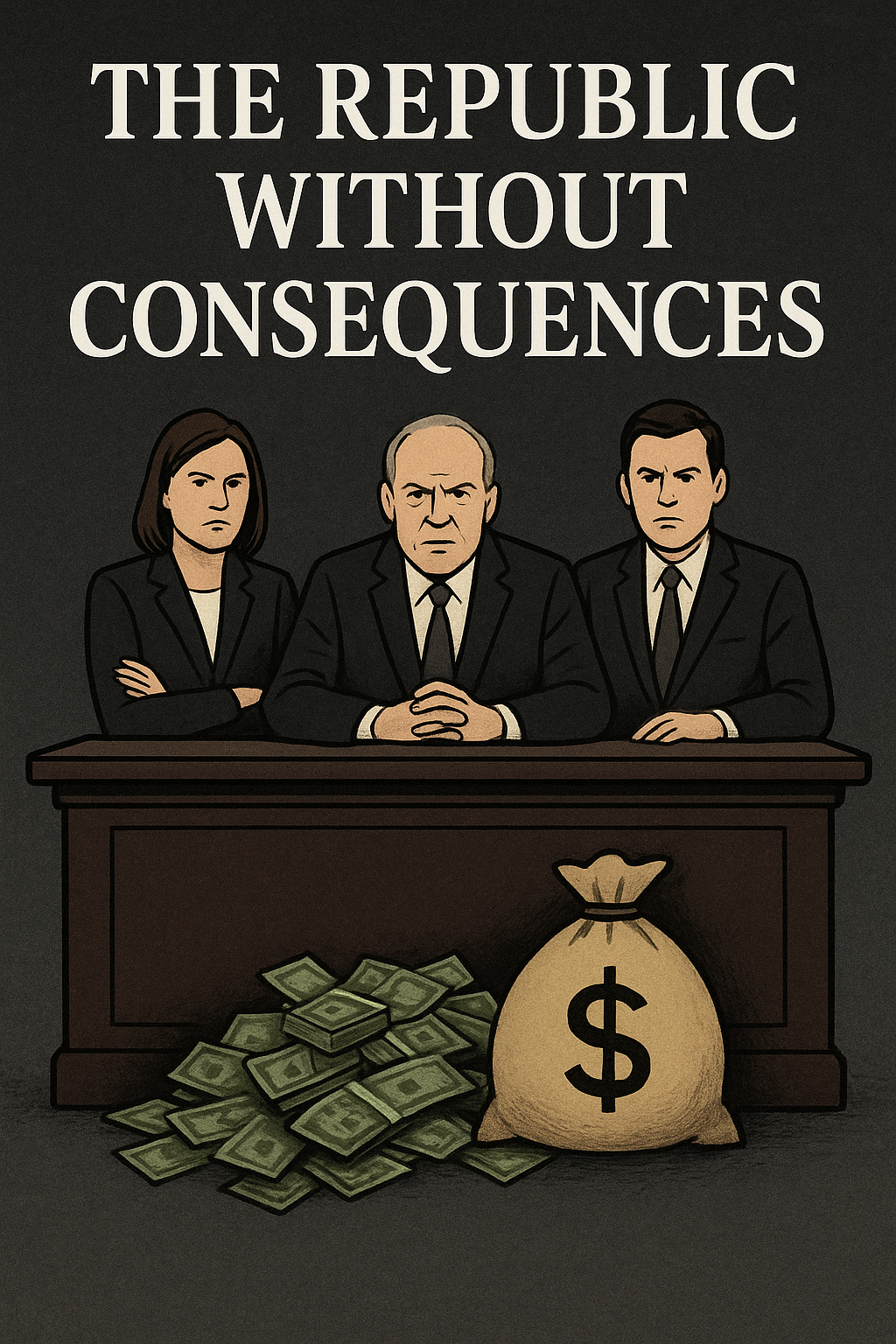
A republic without consequences becomes a performance, a spectacle, a revolving door of professionals who can wreck the machinery of state and still be invited back for another season.
The Performance of Dominance
Shutdowns would end the moment the people responsible for them felt their sting. Debt would shrink the moment lawmakers were forced to own it. And the Constitution, brilliant as it is, would finally confront the one flaw the Founders never imagined: