The Architecture of Control
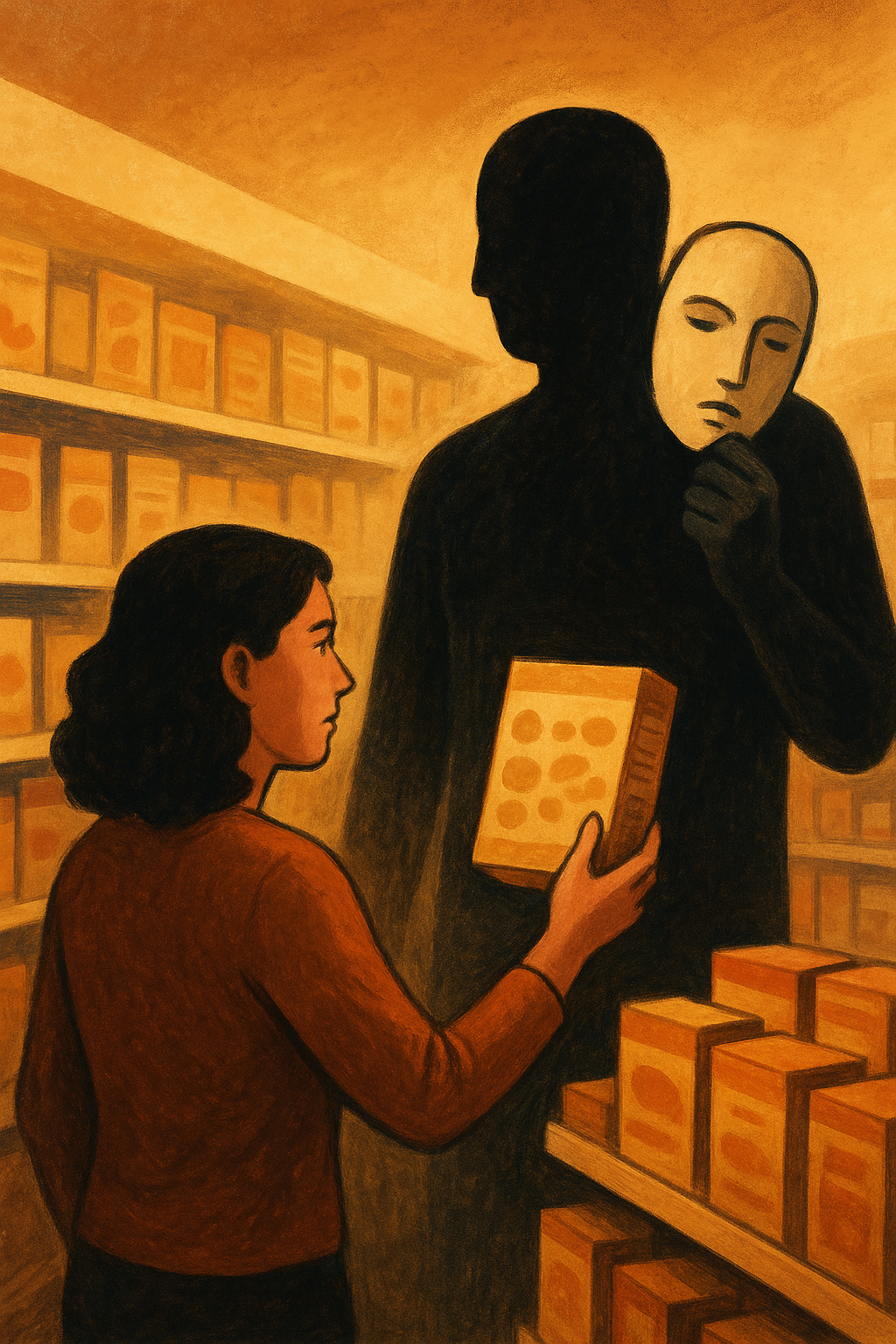
The cathedral of our time is lit by fluorescence, not faith. I stand in the cereal aisle, a canyon of cardboard and crinkled plastic, my cart my pew. My own hand reaches for the brand I always buy—the artisanal muesli that signals discernment, a tiny flag of identity planted in the daily soil of breakfast. This choice, like so many, is a performance of a self I wish to be. The anesthesia, I realize with a start, is not just in the system; it’s in my own veins.
The Machinery of Power
I think of Janice, a nursing assistant I know. I picture her here after a double shift, her shoes squeaking on the polished floor, the scent of antiseptic still clinging to her scrubs. For her, this aisle isn’t a kingdom of choice; it’s a labyrinth of calculations. She isn’t choosing a breakfast; she’s solving for ounces-per-dollar, for which brand her son won’t refuse, for the hollow feeling of the store-brand bag that always tastes faintly of dust. Her freedom is a nesting doll of financial anxiety. And I, with my basket of curated grains, am a willing participant in the fiction that our choices here are of the same kind, that we are equal sovereigns in this consumer republic.
Beyond the Surface
We have been re-educated. The architecture of our sedation is so seamless we mistake it for the sky. The powerlessness. They have taught us to debate the menu while they own the restaurant.
The Logic of Domination
This re-education begins with an Architecture of Distraction. Choice masquerades as autonomy. The click of a button delivering a package, the swipe of a screen summoning a car—each transaction is a tiny lesson in a false agency. A democracy can hollow out, its institutions becoming fragile shells, while its supermarkets remain bursting. The belly is full, the mind is pacified, and the republic quietly dies of a thousand small, convenient surrenders. I hear it in the sigh of someone opting for the pre-selected “I Agree” on a terms-of-service contract longer than the U.S. Constitution.
A Deeper Mechanism
When distraction fails, Manufactured Complexity rears up, a bureaucratic mycelium whose hidden filaments choke the roots of understanding. I remember trying to help my father decipher a hospital bill, a document of such byzantine cruelty it felt like a weapon. Codes, modifiers, network exceptions—it was a language designed to be incomprehensible, to exhaust the will to fight. The tax code, a budget negotiation, a foreign policy briefing: these are fog machines. When the world becomes too complex to navigate, people retreat into the simple, brutal comfort of “us versus them.” They accept slogans because analysis requires light, and the fog is too thick.
The Instruments of Authority
This curriculum is honed in our foundational institutions. In school, we learned civics as mythology, a parade of marble heroes and manifest destiny. We were taught to pledge allegiance to the flag, but not to question whose interests it served when the winds of profit began to blow. Power was presented as a monument, not a contest. The factory bells of education conditioned us to see authority as natural, its structures as immutable as gravity.
The Calculus of Power
The training is finalized by three great obedience factories. First, The Economy: Exhaustion as a Governance Model. For Janice, precarity isn’t an abstract concept; it’s the leaden weight in her bones at the end of a shift, the calculation of whether she can afford to call in sick. A tired population is a compliant one. There is no energy left for the vigilant work of citizenship when you are drowning in the logistics of survival.
The Theater of the State
Second, Media: The Grand Illusionist. It converts political struggle into a spectator sport, a drama of personalities and scandals. The real, silent shifts of power—the regulatory rollback, the midnight rider inserted into a bill—occur off-camera, while the circus of a tweetstorm dominates the screen. The public imagination is narrowed, taught to want only what it has already been given.
The Anatomy of Submission
This brings us to the heart of the great sedation: The Illusion of Choice as Ritual. We have come to experience democracy as a shopping experience. And at the center is voting, framed as the totality of power. We stand in another line, make another choice between two pre-selected brands, and feel the flush of civic duty. But it is a ritual, stripped of consequence. Real power has migrated to the unelected institutions: the lobbies that draft the legislation, the dark money that funds the campaigns, the permanent security apparatus that operates in the shadows.
The Grammar of Control
To placate us, we are offered symbolic victories. A pride flag on a corporate logo. A viral hashtag for justice. We are told we are free because we can scream our opinions into the digital void, even as we lose the power to protect ourselves from medical bankruptcy or a poisoned water supply. We are given a megaphone and told it is a scepter.
The Shape of the Cage
And yet. Last week, Janice told me a story. Faced with a medical bill she knew was wrong, she didn’t pay it. She didn’t have the hours to spend on hold, the vocabulary to dispute the codes. So she simply… didn’t. It was a tiny, terrifying act of negation. Her defiance was not in winning, but in refusing to play a game she could not win. It was a sovereignty of exhaustion.
The Geography of Influence
This illusion, however, is not stable. History has a rhythm, a slow, grinding pressure that eventually forces the mask to slip. Authoritarianism doesn’t arrive overnight. It seeps in, incrementally, through the erosion of norms. It is the boiling frog strategy, a masterpiece of political thermodynamics. I felt the water grow warmer the first time I saw a “temporary” security measure become a permanent fixture. I heard it in the passive, reassuring voice of a news anchor explaining why a once-unthinkable expansion of executive power was now “necessary.” Each step is so small, so rationalized, that by the time you feel the scalding heat, your muscles are already paralyzed.
The Circulation of Authority
Worse, we have lost the vocabulary to name the beast. We were trained to see tyranny as a matter of a single bad leader’s personality, a villain from a storybook, not as a creeping structural reality. So when it manifests as a thousand-page bill no one has read, or a legal opinion that redefines a right into a privilege, it looks disconcertingly normal. Boring, even.
The Instruments of Consent
The moment the mask comes off is not a dramatic seizure of a palace. It is a press conference. It is a televised reassurance. It is the quiet realization that the institutions built for accountability have been hollowed out—the judiciary captured, the press defanged, the public too exhausted and divided to muster a collective scream.
The Architecture of Acquiescence
This is why the illusion is more dangerous than open oppression. A people will fight the chains they see. A people who believe their bondage is freedom will never think to struggle. Coercion without the consciousness of coercion is the most stable form of control. It is a prison where the inmates lovingly polish their own locks.
The Frontiers of Resistance
Yet, the sedation is not absolute. History is punctuated by the glorious sound of shattering glass. I think of the Civil Rights Movement, when people looked at the architecture of segregation and called it by its true name: power. I think of the union organizers who saw the factory not as a natural law, but as a construct that could be challenged. They reclaimed the vocabulary of power. And that is where it always begins: with naming.
The Economics of Power
It begins when we relearn the grammar of domination—who benefits, who pays, who decides. It starts when we ask not “Which cereal should I buy?” but “Who owns the field?” It demands that we distinguish the siren song of choice from the sturdy, unglamorous bedrock of agency.
The Strategy of Disorder
The task ahead is the work of re-education. It is to strip away the comforting fiction and stare, unblinking, at the machinery. It is to reclaim our right not just to choose from what is offered, but to demand what is just.
The Performance of Dominance
My hand is still hovering in the aisle. The muesli is right there, a testament to my good taste. But Janice’s act of quiet refusal echoes in my mind. The choice is no longer between brands, but between sedation and clarity, between the performance of power and the difficult, messy work of reclaiming it.
The Dialectic of Control
A people trained not to see power will kneel before it. A people who relearn its contours can reshape it. I look at the box in my hand, then place it back on the shelf. The first step is to walk out of the cathedral, empty-handed, into the blinding, uncertain light.