The Architecture of Control
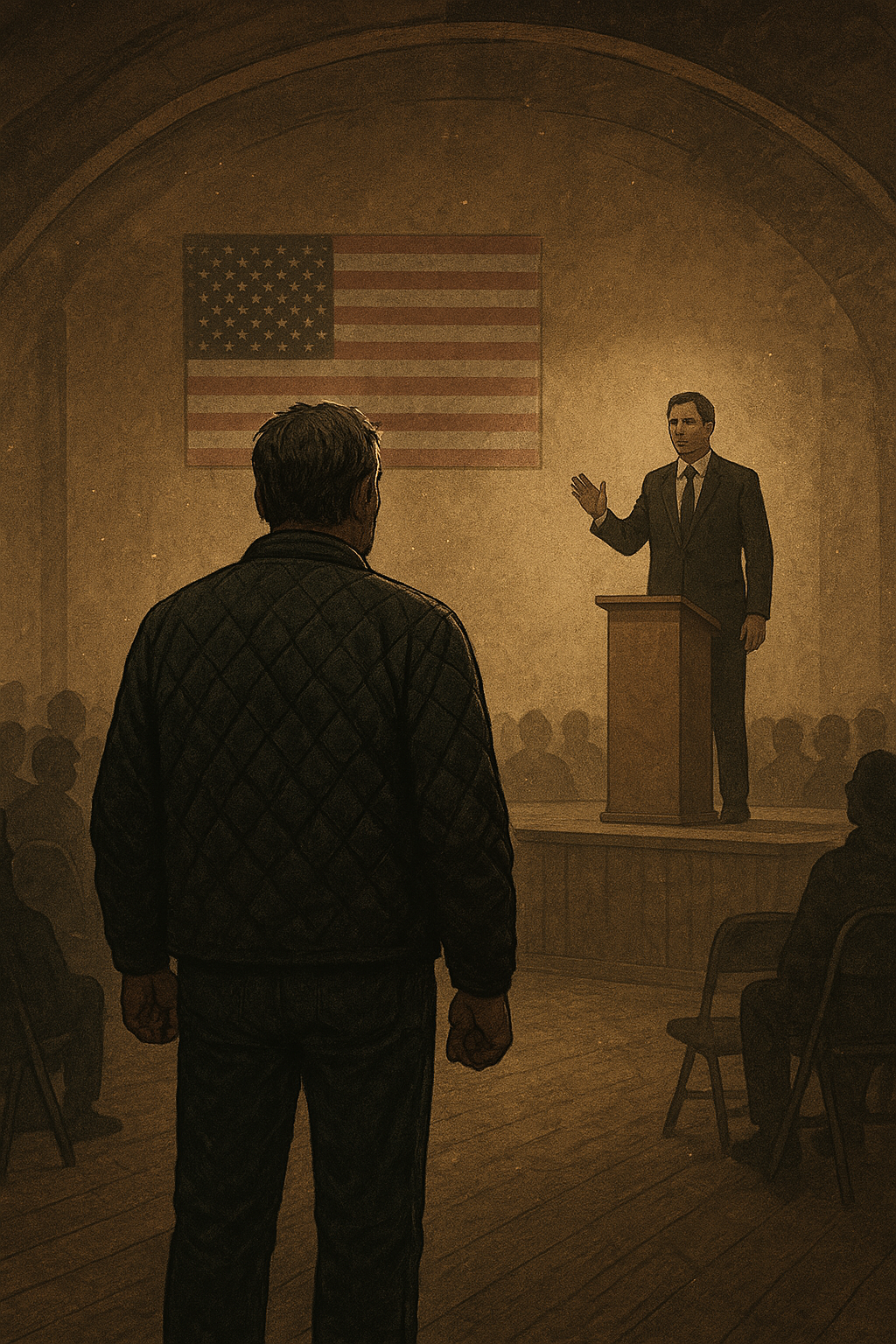
The question hung in the chill of the high school auditorium, a plume of breath drifting into the rafters. A man in a quilted jacket stood with his hands clenched at his sides. The skin on his knuckles was the kind that work carves over decades. His voice did not rise. It wavered, shaped by weariness and a sense of betrayal he could not quite name. “Why,” he asked the congressman on stage, “do we always have money for Israel’s war, but never for the bridge right here?”
The Machinery of Power
The congressman answered with a polished stream about alliances and steadfastness. His words pointed toward a distant necessity. The man in the jacket listened, then lowered himself back into the metal folding chair. His question remained where he left it, lodged like a hairline fracture in the architecture of the room.
Beyond the Surface
This is the real schism in the country. It is not the familiar divide of red and blue. It is a deeper conflict within the priesthood of power must always project itself outward.
The Logic of Domination
To understand this conflict, you must listen to the vocabulary of the inner chambers. I spent an afternoon in a town hall last spring where residents had come to ask why the town council refused to issue a statement condemning Israel’s attack on Gaza. The room had fluorescent lights and folding tables arranged in a horseshoe. People brought printouts from the United Nations, from human rights organizations, from medical groups documenting intentional starvation. The evidence covered the tables like fallen leaves.
A Deeper Mechanism
A council staffer, a man in his forties who spoke with the careful diction of someone used to contentious meetings, listened to each presentation. When it was his turn to respond, he said the situation was complex. He used that word three times in two minutes. Complex. The violence was terrible, he acknowledged, but the historical context was layered, the security concerns were real, the path forward was unclear.
The Instruments of Authority
Someone asked about Ukraine. The staffer’s voice changed. It became clearer, more certain. Ukraine was different. That was aggression, pure and simple. That was a violation of sovereignty. There was no complexity there, no need to weigh competing claims. The contrast hung in the air like smoke.
The Calculus of Power
The structure. He never called it that, but that was what he meant. Alliances, treaties, the whole latticework of commitment that determined which suffering was simple and which was complex. To question it was to question everything. The boundaries of acceptable thought were gently policed, not by conspiracy but by the weight of institutional reflex. The crack in the foundation was painted over again and again until the flaw resembled part of the design.
The Theater of the State
A rhythm like this has echoed through older empires. Close your eyes and it becomes the noise of the Roman Forum. The elite were once split between the Philhellenes and the loyalists of the soil. The Philhellenes had returned from the East with new tastes and new gods. They spoke of Rome as the successor to a higher civilization. Their loyalty reached toward distant ideals.
The Anatomy of Submission
Opposite them stood Cato, unyielding and carved from principle. He saw only the rot of foreign influence. He held figs from Carthage in the Senate and claimed they were proof of a threat that sat too close to ignore. But his real fear was internal decay. He warned that Greek physicians and philosophers were weakening the Roman character. His creed was local. Rome was caught between two destinies. It could become a cosmopolitan empire or remain a rugged nation. It could not be both.
The Grammar of Control
The pattern returns again in the last days of Constantinople. The Emperor, desperate to survive the Ottoman siege, sought aid from the West. He argued for union with the Latin Church, a sacrifice of spiritual independence in exchange for military help. This was a cold calculation, the act of a ruler who believed survival required a foreign god.
The Shape of the Cage
The priests and the people refused. Better the Sultan’s turban than the Pope’s tiara. Their god was the God of the East, woven into their identity. Submission to the West felt like a spiritual death. The empire fractured along this internal fault. While it argued over which master to accept, the breach widened and through it came the future.
The Geography of Influence
But perhaps I am too eager to see patterns. Perhaps the metaphor I have constructed is too neat, the historical rhymes too convenient. The man in the quilted jacket is not Cato, after all. He may want the bridge repaired so that commerce can flow more freely, so that his own investments might prosper. He may want empire too, just a different flavor of it. One that tastes like home.
The Circulation of Authority
And the congressman is not a Byzantine Emperor trading away his soul. He is a man who won an election by promising to be tough on China, to stand with allies, to project strength. His constituents, or at least enough of them, wanted that god as much as the distant one. The voice that demands we choose between gods may be a false prophet. Perhaps there is no choice. Perhaps we have already chosen both, and the tension between them is not a crisis but a feature, the way an arch holds its weight through opposing pressures.
The Instruments of Consent
I do not know if this is true. I suspect it is more complicated than my metaphor allows. But the fracture is real even if the categories are imperfect.
The Architecture of Acquiescence
The two altars are everywhere. One stands in the heartland, welded to the bed of a pickup truck, surrounded by cracked asphalt. The other glows on a tablet at town hall, where one conflict is complex and another is simple, where the structure determines which evidence matters. The question is whether a nation can sustain devotion to both without eventually being torn in half.
The Frontiers of Resistance
History suggests it cannot. But history is written by those who survived to tell it, and survival has many forms. Rome became an empire and lasted centuries. Constantinople fell, but Byzantium had already endured a thousand years. Perhaps fracture is not the end but a transformation.
The Economics of Power
The ending of this story has not been written. It will be shaped by votes, memos, the careful parsing of which suffering is complex and which is not. Yet it will also be shaped by the man who stands up and asks why the bridge is still broken.
The Strategy of Disorder
I met him three weeks later in a grocery store. I recognized the quilted jacket. He was standing in the produce section, examining apples with the careful attention of someone who has learned to stretch a budget. I introduced myself, reminded him of the town hall question about the bridge.
The Performance of Dominance
The crack is still there. It runs through the foundation of the house we all live in. It has not widened into collapse, but it has not been repaired. It simply persists, a flaw we have learned to live with. Whether it becomes a breaking point or simply the way things are will depend on whether we decide it matters more than the distant gods we have been taught to serve.