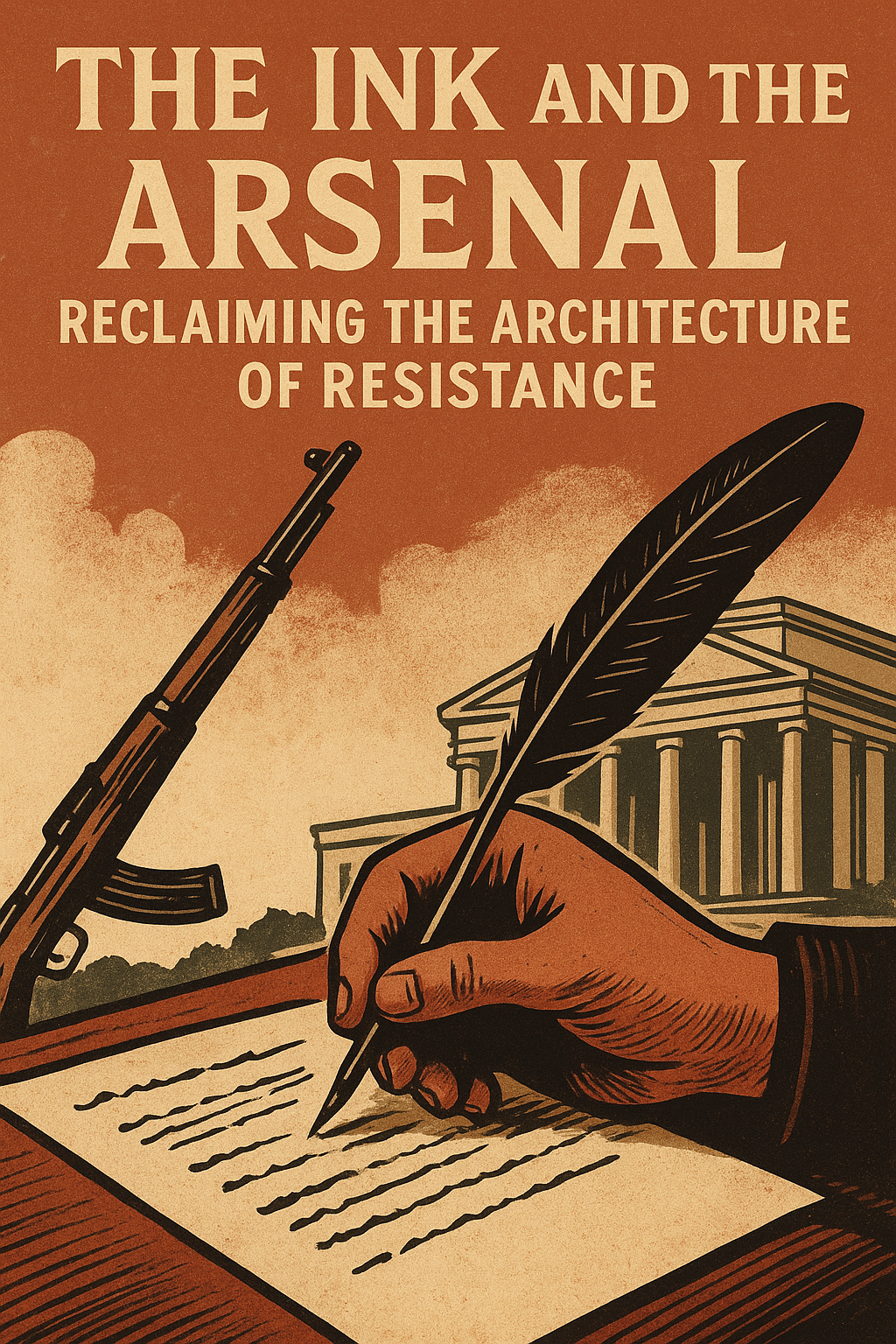
The Architecture of Control
The American landscape is haunted by two rebellions—one written in lead, the other in ink. One reverberates with the percussive algorithmic control may be to rediscover the weight of paper and the depth of a sustained argument.
Beyond the Surface
Imagine, for a moment, the theater of a twenty-first-century insurgency: the romanticized vision of citizen-militias armed with rifles, facing down the state. But pan the camera wider. The landscape is not the dense jungles of Vietnam or the trackless mountains of Tora Bora—it is a nation stitched together by fiber-optic cables and surveilled by a constellation of satellites. The enemy is no longer a column of tanks you can see and hear, but a silent drone hovering at twenty thousand feet, its operator sitting in a climate-controlled room a continent away. The battle is not for a hilltop, but for your digital identity—your social credit, your financial transactions, your very ability to move through the world.
The Logic of Domination
In this hyper-modern panopticon, four hundred million firearms are not a deterrent; they are relics. A rifle cannot firewall a server, decrypt a propaganda broadcast, or shield a community from the slow psychological siege of disinformation. The belief that violent resistance remains feasible is a failure of imagination—not of military potential, but of understanding how power now functions.
A Deeper Mechanism
Power today is not merely enforced at the barrel of a gun; it is woven into the code of our existence. It thrives in curated feeds that amplify our outrage and our biases, in shadowy architectures that nudge our behavior, in algorithmic governance that can silence a voice without a soldier ever lifting a truncheon. A government bent on control need not send troops to your door; it can simply demote your dissent into obscurity, freeze your commerce, and relegate your identity to the digital hinterlands. Against such soft, insidious tyranny, a bullet is a meaningless reply. It is like trying to cure cancer with a sword.
The Instruments of Authority
The true resistance must be waged on the same plane where the oppression occurs: the plane of consciousness itself. That is the sovereign domain of the First Amendment.
The Calculus of Power
This is not a call for pacifism born of weakness, but for a strategy born of clear-eyed pragmatism. Consider the ultimate cost of the Second Amendment absolutist’s path. Even if, by some historical miracle, a ragtag insurgency could impose a cost on the state, the price would be measured in shattered families, smoldering cities, and a national soul scarred beyond recognition. The ghosts of such a conflict would haunt our land for centuries.
The Theater of the State
The victories of Gandhi, Mandela, and King were not bloodless, but they were won by making the state’s violence visible—by holding a moral mirror to its brutality, and by exhausting its will to oppress through the relentless force of presence and speech. They triumphed because they mastered the narrative. They understood that to change a regime, one must first change the minds of those who live under it. This is the higher, harder, and more enduring form of resistance.
The Anatomy of Submission
And so we must turn our energy from stockpiling ammunition to rebuilding the architecture of discourse. If the state can co-opt Big Tech to govern algorithms and shrink the Overton window into a digital keyhole, then our response must be a great, deliberate exodus. We need a renaissance of print media and long-form thought. There is a radical slowness in the rustle of a newspaper, a tangible weight to a monthly journal that demands a different kind of attention.
The Grammar of Control
Algorithms favor the explosive, the simplistic, the emotionally charged. They thrive on the dopamine hit of the share and the retweet. But a printed page, a bound book, a substantive essay—these are mediums of contemplation. They cannot be skipped with a scroll or dismissed with a sneer. They require the reader to lean in, to follow a linear argument, to sit with a complex thought in the quiet chamber of their own mind.
The Shape of the Cage
Imagine clandestine presses buzzing in basements, not printing manifestos of violence but journals of relentless inquiry. Imagine essays, rich with data and narrative, passed hand to hand like samizdat literature—their physicality a testament to their substance. This is not nostalgia; it is evolution. A digital post can vanish in an instant with a censor’s click. But a library, a community bookshelf, a box of pamphlets buried in the earth—these become distributed, durable archives of truth.
The Geography of Influence
In an age of digital ephemerality, the printed word becomes a fortress. Reading a long-form article becomes an act of rebellion against the fractured attention economy that serves the powerful. The book club, the reading circle, the public forum—these are the new cells of resistance, dedicated not to paramilitary training but to the more subversive work of critical thought and empathetic understanding.
The Circulation of Authority
The Second Amendment will always occupy a corner of the American psyche—a final, desperate failsafe against a tyranny we can scarcely imagine. But to treat it as the primary tool of liberty is to bring a musket to a cyberwar. It is to fight the last war. The frontier of freedom has shifted from the open field to the human mind, from the town square to the digital stream.
The Instruments of Consent
Our most potent weapon is not the capacity for violence but the will to speak, to publish, to assemble, to reason. It is to build parallel structures of meaning—robust, thoughtful, humane. Let the state have its algorithms and its surveillance; we will build our redoubt from ink and ideas, from pages that cannot be deleted and arguments that, once planted in a fertile mind, can never truly be erased.