The Architecture of Control
There is a tyranny more profound than brick and bar, more insidious than the sword or the law. It is not forged in the world of things but in the soft, grey corridors of the mind. It is a fortress built from the inside out—walls mortared with inherited fear, spires raised from convenient dogma, foundations sunk deep into the riverbed of habit.
The Machinery of Power
I have always understood oppression not as a cage for the body, but as a generations-long project: the careful architecture of the soul’s own prison. A person in chains whose thoughts still range free as a hawk over mountains carries within them the seed of their liberation. Their limbs may be bound, but their imagination still traces the topography of freedom. The true captive, the one who evokes a pity that aches like an old wound, is the one taught to love their chains—to find comfort in confinement, to mistake the flickering shadows on the cave wall for the sun itself.
Beyond the Surface
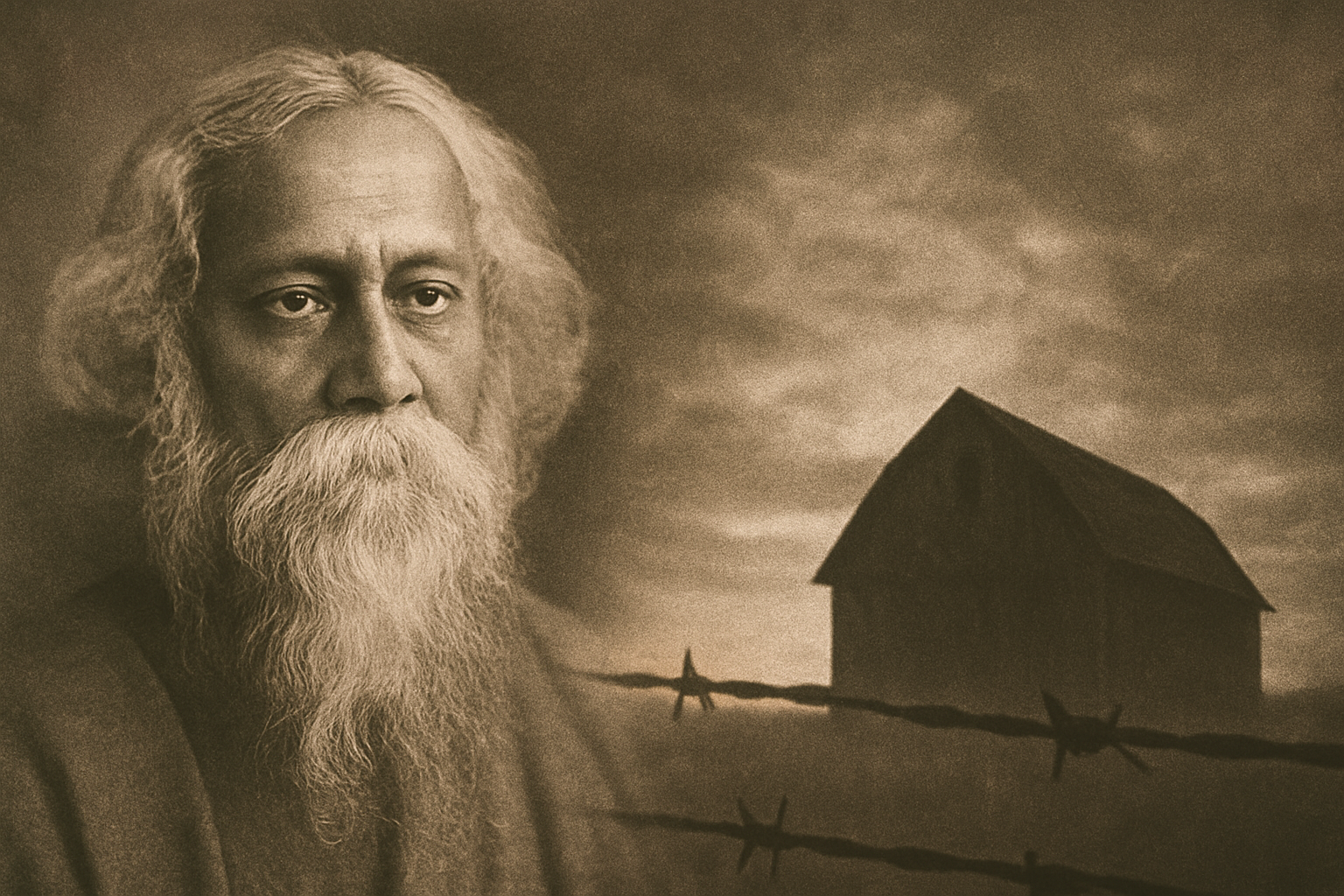
This internal colonization is what Rabindranath Tagore invoked when he dreamed of a heaven of freedom. His prayer was not for a mere transfer of power but for a psychic unshackling—a revolution of the interior world. “Where the mind is without fear and the head is held high,” he wrote, distilling into a single line the antithesis of tyranny. A bowed head is not just a posture; it is a diagnosis. His heaven is no distant paradise, but a state of being where “knowledge is free,” where the world is not “broken up into fragments by narrow domestic walls.”
The Logic of Domination
The most haunting image in his prayer is of a mind “led by ever-widening thought into that dreary desert sand of dead habit.” That desert is the oppressor’s masterpiece—not a landscape of forced labor, but a spiritual wasteland where no new idea can take root, where the winds of change serve only to bury the relics of the past deeper beneath the sand.
A Deeper Mechanism
The technique of this conquest is a study in psychological sorcery. The oppressor does not merely issue commands; he edits reality. He redefines words until “freedom” means obedience and “truth” becomes whatever the loudest voice declares. He scrubs history clean—bleaching the blood from its pages, erasing the names of those who dared to dream differently—until the present order seems as natural and inevitable as sunrise. He cultivates fear of the Other, that potent tribal reflex which convinces the flock that the shepherd’s crook is their only protection from imagined wolves.
The Instruments of Authority
Certainty becomes the sweetest narcotic. It is easier, the frightened heart whispers, to live in a small, predictable cage than to face the vast, unmapped wilderness of freedom.
The Calculus of Power
And so, in time, the oppressed become master artisans of their own captivity. They learn the rhythms of the prison so intimately that its bars begin to feel like ribs—protective, familiar, indispensable. They police themselves and one another, finding comfort in the choreography of compliance. This is the unbearable truth that Orwell carved into Animal Farm.
The Theater of the State
The animals, drunk on the heady wine of revolution, overthrow Farmer Jones and shatter their physical bonds. For a moment, the mind is without fear; hope surges like spring water. They inscribe their Seven Commandments upon the barn wall—a manifesto radiant with promise. But the old architecture of submission endures, buried in the folds of habit. The pigs, shrewd and eloquent, merely move into the farmhouse. The bars are internal now, and the prison needs only a new warden.
The Anatomy of Submission
The sheep, reduced to a single bleating refrain—“Four legs good, two legs bad”—are perfect citizens of this new-old regime: docile, rhythmic, thoughtless. Boxer, the loyal carthorse, embodies a tragedy of devotion—his strength limitless, his mantra fatal: “I will work harder.” When the commandments collapse into the single cynical truth—“All animals are equal, but some animals are more equal than others”—the horror lies not in the words, but in the silence of those who witness their erasure.
The Grammar of Control
How, then, does one revolt against an empire of the mind? How does one break chains one has been taught not to see? The first act of rebellion is almost imperceptible—a whisper, a question, a thought that dares to contradict. Freedom begins as heresy. It is the slow, painful excavation of consciousness—the intellectual archaeology of unearthing buried truths, lost songs, forbidden histories. To drain the desert of dead habit, one must find the underground rivers that still run beneath it.
The Shape of the Cage
But a single awakened mind is a spark easily snuffed. It must find other sparks. In cafés and dim backrooms, in glances exchanged between those who see, the circle of trust begins to form. Here, language is reclaimed. The slur is stripped of its venom; the euphemism is unmasked. New stories take root—narratives where the oppressed are not victims but protagonists of their own becoming.
The Geography of Influence
From these quiet circles, resistance takes form. Not in the clash of armies, but in the defiant rhythms of daily life—the mother singing a forbidden lullaby in her native tongue, the worker who follows the rules too precisely, the artist who paints truth disguised as beauty. These small acts are the first architecture of freedom: the free school beneath a tree, the underground press, the garden planted on forbidden ground. They are blueprints for Tagore’s heaven, drawn in the dust of the fallen world.
The Circulation of Authority
But liberation, once won, must be guarded from becoming dogma. The tragedy of Animal Farm is not that power corrupts, but that memory fades. Each generation must win its freedom anew. The freed must become teachers, not rulers. They must hand down not creeds but questions—not commandments but curiosity. They must raise their children to fear not the wildness of thought but the sterility of habit.
The Instruments of Consent
For the ultimate victory is not the overthrow of Farmer Jones, nor the repainting of commandments. It is the creation of a people for whom freedom of mind is sacred—a people who would rather navigate the terrifying, luminous uncertainty of a star-marked sea than retreat to the dull safety of a walled-in shore.
The Architecture of Acquiescence
And when the next pig rises on its hind legs, whip in hand, there will be no bewildered sheep, no broken Boxers—only clear-eyed beings who remember, who refuse, who whisper across the ages, “We have seen this before. And we will not build this prison again.”