The Architecture of Control
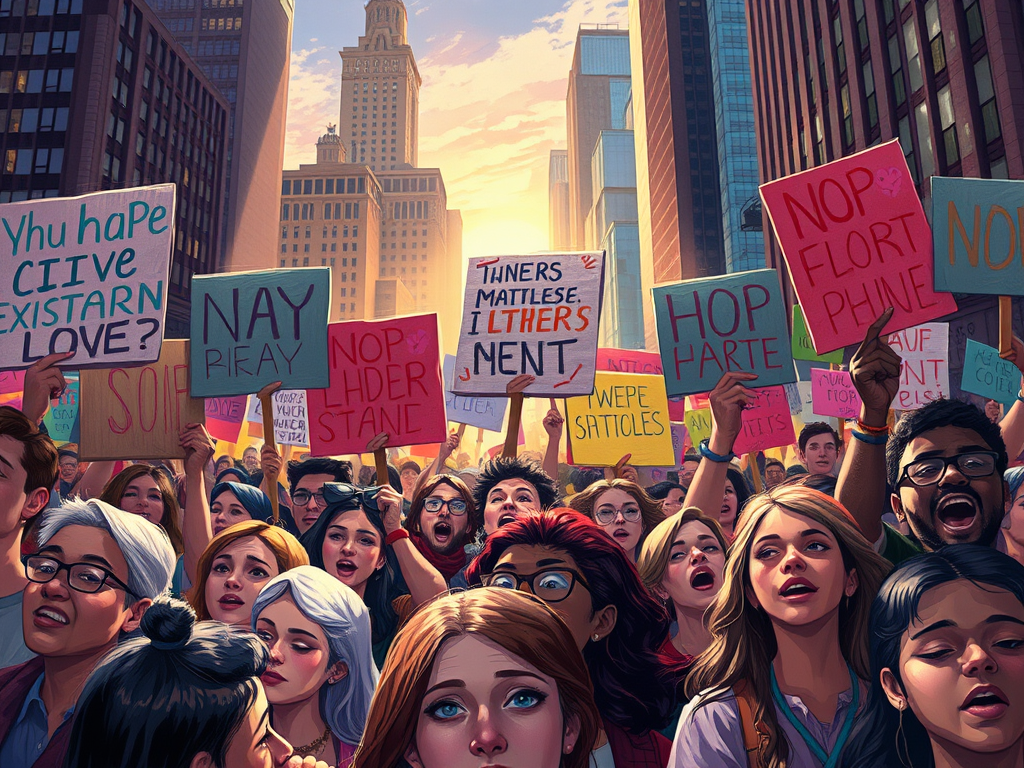
The protest is a algorithms on our phones offer us a curated, sanitized version of our own outrage. The politicians issue statements that are masterclasses in saying nothing. The streets are cleaned, the placards recycled, and a profound, hollow silence descends. The ghost remains, but its power to terrify the powerful has faded. Why? The answer lies not in a failure of our spirit, but in a fundamental transformation of the fortress we are trying to storm.
Beyond the Surface
Let us journey back, for a moment, to the age that birthed our modern protest mythology—the 1930s through the 1960s. Picture it not in black and white, but in the stark, primary colors of concentrated, visible power.
The Logic of Domination
The political analyst, leaning over blueprints of the past, would describe this as the era of the Cathedral. Power was a physical, tangible thing. It was housed in smokestacked factories where a single owner’s decision could alter the destiny of a thousand families. It was embodied in the person of a mayor, a governor, or a president, men you could theoretically corner, their images fixed in the daily newspaper. The media was a monologue, broadcast from three networks and a handful of press barons, creating a unified national stage. A protest, in this world, was a direct assault on the cathedral doors. It was a physical blockade of the factory gates, a moral spectacle on the Edmund Pettus Bridge, a human tide filling the National Mall. The goal was to create a crisis of legitimacy so visceral, so impossible to ignore, that the men in the cathedral had to open the windows and listen.
A Deeper Mechanism
Now, step into the 21st century. The Cathedral has not been demolished; it has been dissolved. The political analyst, influenced by the ghost of C. Wright gig economy? Power now resides in the ethereal realm of data flows, in the clandestine meeting of lobbyists and legislators that is never photographed, in the unaccountable content moderator in a distant time zone, in the proprietary algorithm that dictates what news you see. The modern protester arrives with a pickaxe, ready to break down a door, only to find themselves swinging at a mist. We are shouting at a distributed network, and a network has no ears, only firewalls.
The Calculus of Power
The historian nods, seeing the grim rhyme. The tactics of the past were designed for a system that could feel shame and fear a concentrated, disruptive crowd. Today’s system feels no such thing. A march of a hundred thousand is processed as a data point, a momentary blip in sentiment analysis, a logistical problem for the police department. The images are filtered, hashtagged, and commodified, becoming just another piece of content in the endless scroll. The spectacle is neutralized by a greater, more pervasive spectacle: the digital noise of modern life itself.
The Theater of the State
This brings us to the most seductive and ultimately debilitating myth of modern activism: the 3.5% rule. It is a neat, clinical statistic, promising a mathematical shortcut to revolution. The theory, derived from studies of historical non-violent campaigns, suggests that once 3.5% of a population is actively participating, success becomes inevitable. It is a beautiful, dangerous fairy tale.
The Anatomy of Submission
The historian, sifting through the fine grain of context, scoffs at this numerical alchemy. The success of the Civil Rights Movement or the fall of the Berlin Wall was not a simple matter of hitting a magical participation quota. It was the result of a perfect, unrepeatable storm. It required a moral clarity that could be communicated through the limited media of the time—a photograph of a firehose, a newspaper headline. It operated against a backdrop of a tangible, often brutal, state opponent whose violent overreaction could be its own undoing. It existed before the invention of mass surveillance, predictive policing, and the psychological fragmentation of the digital public sphere.
The Grammar of Control
To believe in the 3.5% rule today is to believe that you can win a cyberwar with a bugle and a cavalry charge. The modern power structure is immunized against the traditional protest virus. It has developed antibodies: mass surveillance that preempts organization, legalistic maneuvering that criminalizes dissent, and a media ecosystem that can spin, divide, and dismiss any movement with breathtaking efficiency. The 3.5% might be mobilized, but they will be mobilized into a labyrinth with no center, their energy dissipated across a thousand digital dead ends, their unity shattered by algorithmic discord. The rule is not a strategy; it is a relic, a comfort blanket for activists shivering in the cold new world.
The Shape of the Cage
So, do we surrender? Do we concede the field? Absolutely not. We must simply trade our old maps for a new cartography of change. The goal is no longer to create a momentary spectacle, but to build a permanent, resilient counter-power. We must stop shouting at the mist and learn to become the weather.
The Geography of Influence
The essayist, with a poet’s eye, sees the new path not as a march, but as a mycelial network—a silent, subterranean, interconnected web that nourishes a forest of resistance from below. Here is an alternate roadmap:
The Circulation of Authority
The ghost of the 20th-century protest can finally be laid to rest. It was noble. It was necessary. But its time has passed. We stand now at the edge of a new wilderness, armed with tools we are only just learning to wield. The work ahead is quieter, deeper, and less photogenic. It will not always make the headlines. But it is the only work that can build a foundation strong enough to hold the weight of a better world. Stop marching toward the mirage. Start digging where you stand. The real revolution begins not with a shout, but with a seed, planted in the dark, waiting to split the stone.