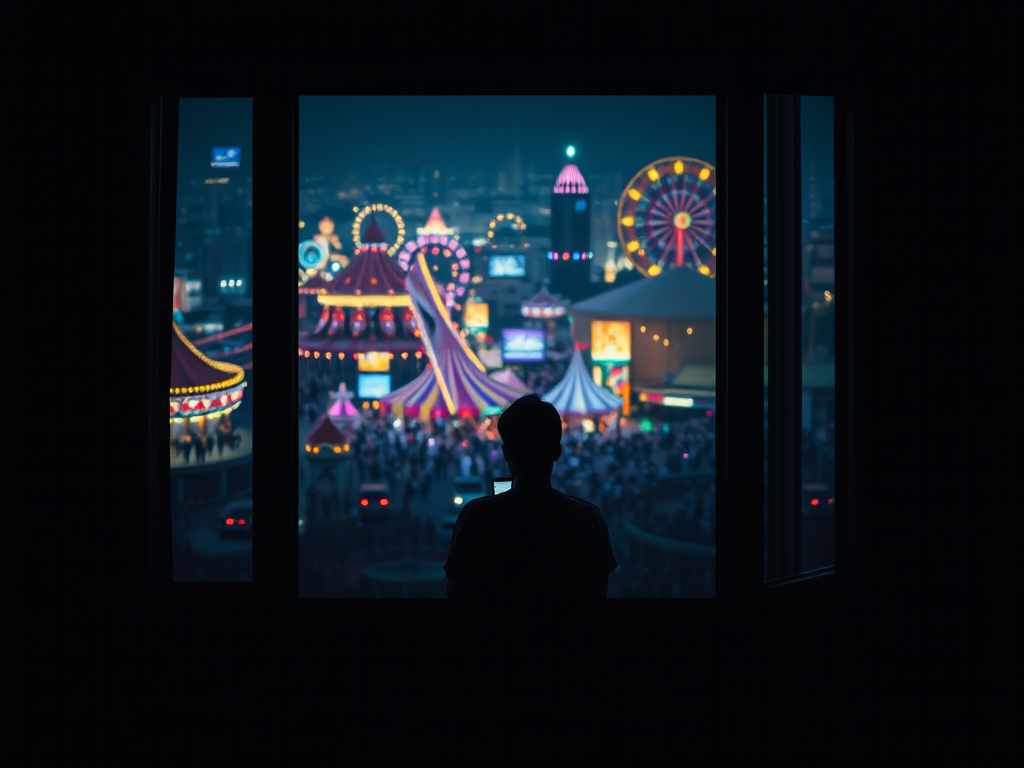
The Architecture of Control
My screen is a window into a carnival. A whirl of faces, a fireworks display of opinions, a ceaseless parade of achieved dreams. My thumb scrolls, a gentle metronome keeping time with the global pulse. I am everywhere. I am connected. And then, the scroll stops. The carnival vanishes. I am left in the sudden quiet of my room, the only sound the faint electronic sigh of the device going dark. The stillness it leaves behind is a physical weight. This is the central paradox of our age: we have never been so adept at building bridges, yet we find ourselves stranded on islands of our own making, living in an architecture of absence.
The Machinery of Power
We have become artisans of the self, and our medium is light. We sculpt our likenesses from the clay of daily life, firing them in the kiln of public perception. This digital avatar is a masterpiece of curation—witty, resilient, enviable. It is a fortress. But a fortress, by design, is built for siege, not for embrace. The connections we form in this performative space are transactions between sentinels, each guarding the vulnerable, trembling creature within. We exchange polished stones across the ramparts, mistaking the clatter for conversation. True intimacy, the kind that warms the bones, requires a lowering of the drawbridge. It requires showing the undefended city, the tangled, overgrown gardens, the crumbling, unremarkable walls. Our digital economy has no currency for this.
Beyond the Surface
And watching over this economy is the silent architect: the algorithm. It is a master cartographer, drawing maps of our desires that are perfectly accurate and utterly barren. It builds us a city of echoes, where every street corner reflects our own face, every voice sings our own song back to us. This feels like belonging. It is not. It is a sensory deprivation tank for the soul. The friction of otherness—the friend whose joy comes from sources we find baffling, the colleague whose sadness wears a face we cannot recognize—is sanded away. We are left with a smooth, seamless, and profoundly lonely consensus. We are connected to a chorus of our own echo, and the silence that follows is the sound of a world that has stopped talking back.
The Logic of Domination
This system demands velocity. It thrives on the instant, the immediate, the now. The ping of a notification is a siren song, pulling us away from the slow, meandering river of a real conversation. We have replaced the shared gaze, the thoughtful pause, the sentence abandoned and rediscovered, with the efficient transfer of data. “lol,” we type, where once we would have laughed. We have sacrificed communion on the altar of contact. Intimacy is a patient art, built not in the bright, brief flash of a text message, but in the long, twilight dim of shared presence. It is the silence between two people that is not empty, but full. The digital world has no grammar for this kind of quiet. It is all noun and verb, with no room for the prepositions and pauses that give relationship its meaning.
A Deeper Mechanism
The result is a haunting. We become dwellings partitioned between the furnished, public rooms and the locked attic where the true self resides. Loneliness is the cold draft from under that locked door. The modern malady we call FOMO is not a fear of missing a party. It is the spectral terror of our own avatar fading, of becoming a powerlessnessghost in the very machine designed to proclaim our existence. It is the fear that the performance is all there is.
The Instruments of Authority
The way out is not to destroy the carnival, but to learn when to walk away from its noise. The most radical act is to consciously, deliberately, reintroduce our whole, unedited selves to the world. It is to choose the vulnerable sentence over the witty one. It is to share a failure without the frame of a lesson. It is to sit with a friend in a silence that is not awkward, but deep and resonant.
The Calculus of Power
Imagine a different kind of network. It is not made of light, but of fiber and breath. It is the weight of a head on your shoulder. It is the memory of a story told with stutters and tears, not crafted for captions. It is the glance across a room that speaks a paragraph. This web is woven from shared, unphotographed sunsets and the courage to say, “I am not okay.” It is quieter. It is slower. Its light is the ancient, golden glow of a shared flame, around which we can finally lay down our tools of curation, and warm our hands, and our hearts, in the simple, profound truth of being seen.