The Architecture of Control
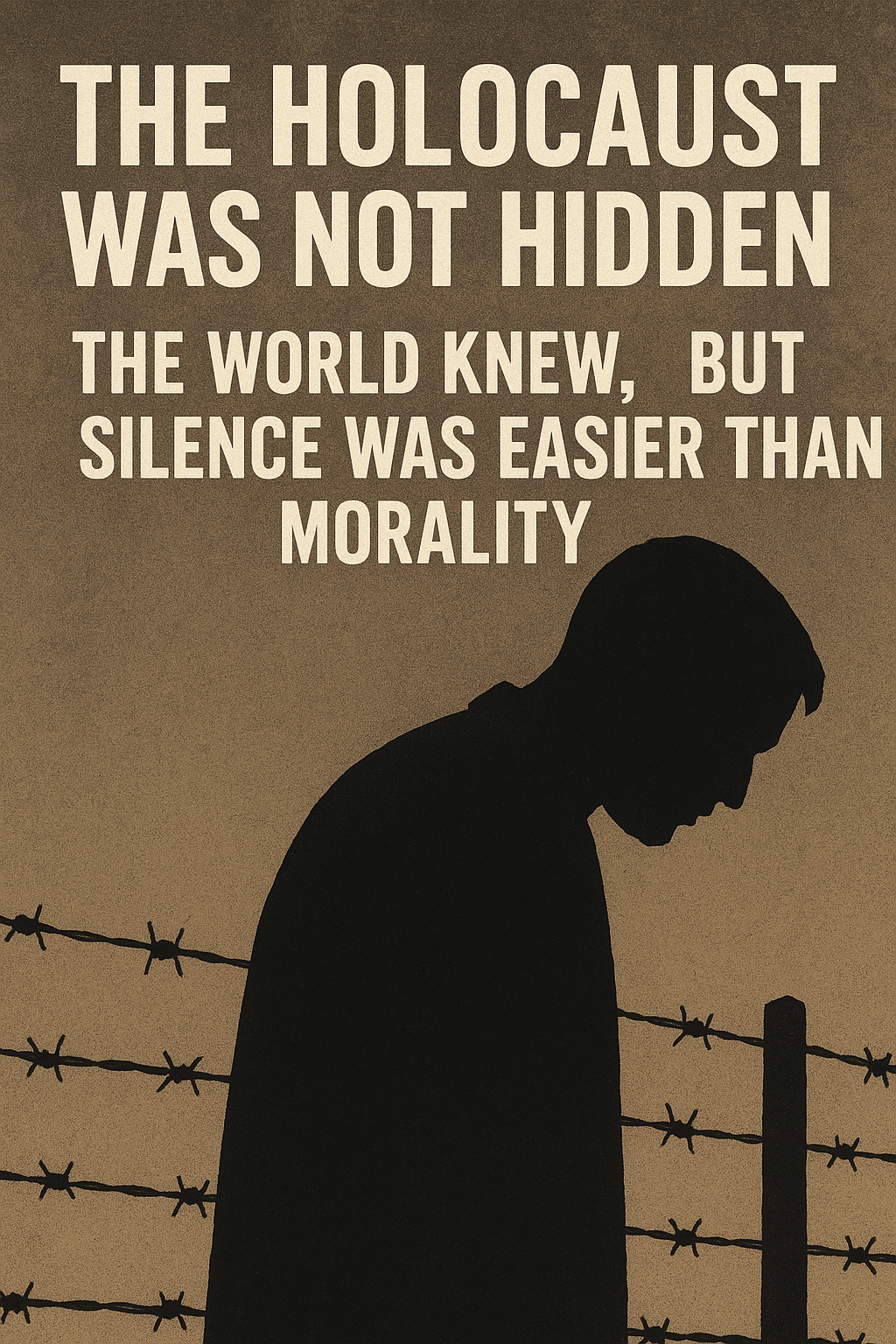
There are questions that arrive like unwelcome guests, refusing to leave no matter how many cups of reason you serve them. Given history’s broken rhymes, the constancy of human nature, and the ongoing murder of innocents, met with silence at worst, and empty words at best from world leaders, I am compelled to question regarding the Holocaust: Did the rest of the world not know?
It’s easy, in hindsight, to assign the shield of ignorance — that people simply didn’t know the trains were filled with human cargo or that the chimneys weren’t factories but furnaces. But history, when stripped of its euphemisms, tells a different story. Many did know. Especially those in power. The whispers crossed borders, the reports made it to desks, and yet, the machinery of denial rolled on. Newspapers frequently buried the genocide through obfuscation; openly calling attention to the murder of millions would severely affect trade deals – for German engineering brought about prosperity to nation states. There were protests in some cities, yes — scattered cries begging governments to act — but they were like drops of rain on iron. The war effort swallowed every other moral urgency, and Jews became the collateral of silence.What disturbs me most is not just the silence, but the ease with which it was rationalized. Antisemitism was not manufactured in some secret Nazi laboratory; it was already woven into the cultural fabric of Europe. The propaganda simply gave it a uniform, a salute, a purpose. The hatred was latent, waiting for permission to speak. What the Nazis did was systematize that prejudice, give it bureaucratic order — hatred made efficient.
The Machinery of Power
After the war, as the world looked at the camps and gas chambers, it realized that the absence of a moral compass had cost humanity its own reflection. The phrase “Never Again” became both a promise and an apology. And from the ashes of the League of Nations — an institution too timid, too bound by sovereignty to prevent such horrors — arose the United Nations.On paper, it was a monumental leap. The League had spoken of peace between nations; the UN spoke of dignity within them. For the first time, “human rights” entered the vocabulary of international law — not as a poetic abstraction, but as a legal commitment. The Universal Declaration of Human Rights (1948) was humanity’s attempt to write down its conscience. Every person, it said, had the right to life, liberty, and security — not by the grace of kings or governments, but by virtue of being human.And yet, decades later, that same question returns, unchanged in tone but more cynical in context: has the presence of the UN done anything to prevent human rights abuses?The honest answer is: sometimes, yes — and too often, no.The UN has saved lives through peacekeeping, refugee protection, and global health efforts. But when it comes to confronting powerful states — when the oppressor sits on the Security Council with a veto pen — justice collapses into rhetoric. The five permanent members of the Security Council — the United States, Russia, China, France, and the United Kingdom — hold the power to halt any collective action, even in the face of undeniable atrocities. The same nations that wrote the rules also wrote themselves out of accountability.It is here that Dr. Martin Luther King Jr.’s words echo with painful relevance: “Injustice anywhere is a threat to justice everywhere.” Yet in practice, international justice seems to have a hierarchy — a system where the crimes of the poor are prosecuted and the crimes of the powerful are negotiated. Small nations are sanctioned; large ones are “consulted.” It is as if the moral weight of an act depends not on its cruelty but on who commits it.Justice, as Dr. King envisioned it, was not a compartmentalized virtue — it was a living network, where every act of oppression, however distant, tugged at the thread of our shared humanity. When a society punishes the poor but excuses the powerful, justice is not merely absent — it becomes complicit. The same holds true at the global scale. When the UN condemns the abuses of weaker states but remains paralyzed in the face of the powerful, it becomes a mirror of the very inequality it was created to abolish.It would be unfair, perhaps, to dismiss the UN entirely. It is not a monolith of apathy; it is a structure burdened by its design. The League of Nations failed because it was toothless — bound by the sacredness of sovereignty. The UN, in theory, corrected that by creating binding charters and international courts. But it carried over one fatal flaw: the belief that peace could coexist with inequality of power.And so, we find ourselves in a paradox. The UN Charter begins with the words “We the peoples,” but the decisions are made by the few — those who possess veto power. The world’s collective conscience was centralized into five hands, and those hands have often been red with the same violence the UN was meant to prevent. The result is an institution that can feed the hungry but not stop the bombing; that can document war crimes but cannot name the perpetrators if they sit too high.Sometimes, I imagine what it must feel like to be a victim of a powerful nation’s aggression — to watch your world crumble while the “international community” debates resolutions in air-conditioned rooms. The cameras flash, the diplomats speak of peace, and the world moves on. The suffering becomes a headline, and then a statistic, and then a memory.
Beyond the Surface
Perhaps that is what power does — it teaches the privileged how to narrate suffering without ever feeling it. The League of Nations once believed that peace was a matter of treaties and signatures. The UN believed it could be achieved through shared values. But what both underestimated was how easily morality bends under the weight of self-interest. You can draft the most beautiful declaration in the world, but it means little if it cannot be enforced upon those who violate it.And yet, I hesitate to surrender to cynicism. For all its failures, the UN remains the only platform where the smallest nations can still speak — even if their words dissolve into the diplomatic ether. It is flawed, yes, but so is every human attempt at collective morality. The tragedy is not that it is imperfect, but that we mistake its existence for proof that justice exists. The truth is harsher: justice, as it stands today, is not blind — it is selective. It peers through a lens colored by geopolitics and economics. When the rich commit crimes, we call it intervention; when the poor resist, we call it terror.And yet, the ideal — fragile and flickering — still matters. It matters because without it, all we have left is the law of strength. It matters because every now and then, a refugee is resettled, a famine is averted, a ceasefire holds, however briefly. These moments do not redeem the failures, but they remind us that humanity still resists its own indifference.When I think back to that first question — did the rest of the world not know? — I realize that ignorance was never the true villain. It was apathy disguised as helplessness, morality outsourced to institutions, and justice deferred until it no longer mattered. The League of Nations taught us that peace cannot exist without accountability. The United Nations, in its own flawed way, has taught us that accountability cannot exist without equality.Maybe that’s the lesson we keep refusing to learn: that the architecture of justice cannot be built on the scaffolding of power. Until justice belongs to everyone, it will belong to no one.In a world where laws are enforced only on the powerless, justice becomes not a system, but a story — one we tell ourselves to feel civilized. And perhaps the first step toward reclaiming it is to stop mistaking order for peace, or silence for stability.Because the silence that followed the Holocaust was not the silence of peace. It was the silence of complicity.And the silence that follows injustice today — in the rubble of Gaza, in the prisons of Xinjiang, in the forgotten corners of Africa — is not ignorance either. It is the same old quiet, dressed in modern diplomacy.History doesn’t repeat itself; it rhymes with different accents.And as long as power decides which lives are mourned and which are measured, the rhyme will continue —soft, civilized, and deafening.