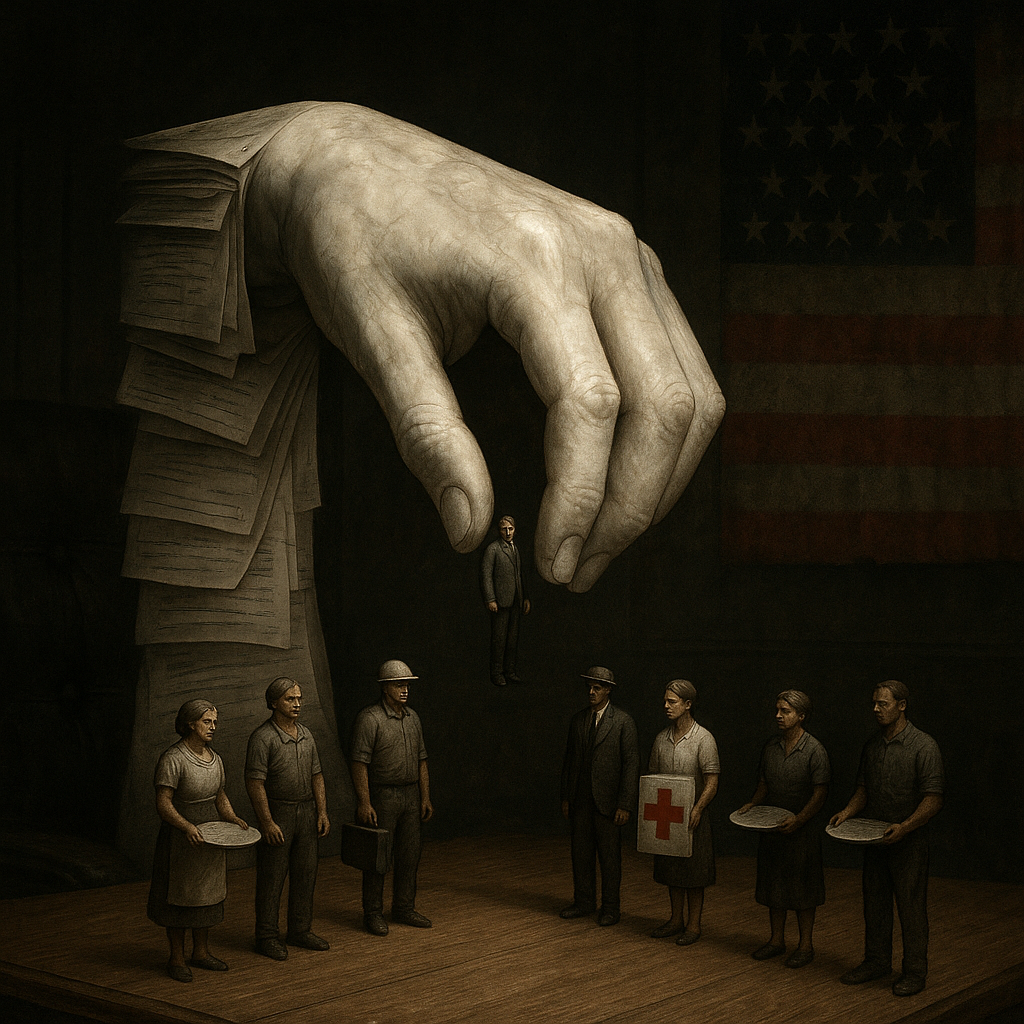
The Architecture of Control
The machinery of power, a deliberate performance where the vulnerability of the marginalized is the central prop, and the script is written to reinforce a singular, brutal truth: sustenance is not a right, but a privilege granted by the powerful, and it can be revoked to make a point.
The Machinery of Power
At its core, the USDA’s ultimatum to produce paperwork or lose food stamp funding is an act of what Pierre Bourdieu termed symbolic violence, the imposition of a worldview through institutions that makes power relations feel natural and inevitable. Here, the worldview is one of suspicion and punishment, directed not at fraud, which is statistically minimal in SNAP, but at the very act of governance by political adversaries. This is coercive federalism weaponized. The federal fist, clenched by one partisan ideology, is not merely withholding funds, it is demanding that subservient jurisdictions perform a ritual of obedience. The demand for “detailed documentation” is a test of fealty. The implicit threat is the creation of a crisis of hunger, a manufactured emergency that will strain state budgets, overwhelm local charities, and, most crucially, inflict tangible suffering on the poorest citizens. Those citizens, the working poor, children, the elderly, the disabled, become pawns in a fiscal chess game. Their empty refrigerators are not an unintended consequence, they are the intended leverage. The social contract. The power dynamic at play is a form of institutional sadism, where the capacity to inflict administrative suffering is a key currency of control. The Democratic led states are not innocent martyrs, they are players in a game whose rules they did not write but are forced to navigate, their power constrained and reactive. The real targets, however, are always those without a lobbyist, without a seat at the negotiating table. The working class family, the gig economy worker, the chronically ill, they exist in the crosshairs of this conflict. Their bodies, their health, their children’s nutrition, are the terrain upon which this battle for ideological supremacy is fought.
A Deeper Mechanism
What we are witnessing is the transformation of the welfare state from a mechanism of social solidarity, however flawed, into a site of permanent political contestation. Its maintenance is no longer assumed, it is a daily struggle. This serves the powerful perfectly. It consumes the political energy of their opponents, it provides a constant stream of crises to be managed rather than problems to be solved, and it continuously re educates the public to expect less, to fear more, and to see their neighbor’s receipt of aid not as a shared benefit but as a political provocation. This is the essence of hegemonic control, achieving dominance not by outright prohibition, but by making the alternatives seem chaotic, unaffordable, and fraught with risk.
The Instruments of Authority
The profound and unsettling realization is this, the manipulation of basic human need, food, medicine, shelter, has become the primary grammar of American political power. We are no longer debating the size of the safety net, we are debating whether the authorities holding the net will be allowed to keep their grip, or if the net itself will be cut to teach them a lesson. The violence of this approach is slow, bureaucratic, and legal. It arrives not with a truncheon but with a form to be filled in triplicate, a funding deadline, a sunset provision. And in the quiet that follows the political headlines, in the kitchens and clinics where uncertainty makes its home, the message is received, understood, and internalized. Power whispers, and its whisper is the sound of a stomach tightening, of a prescription going unfilled, of a lesson learned about who truly governs, and what they are willing to sacrifice to prove it.