The Architecture of Control
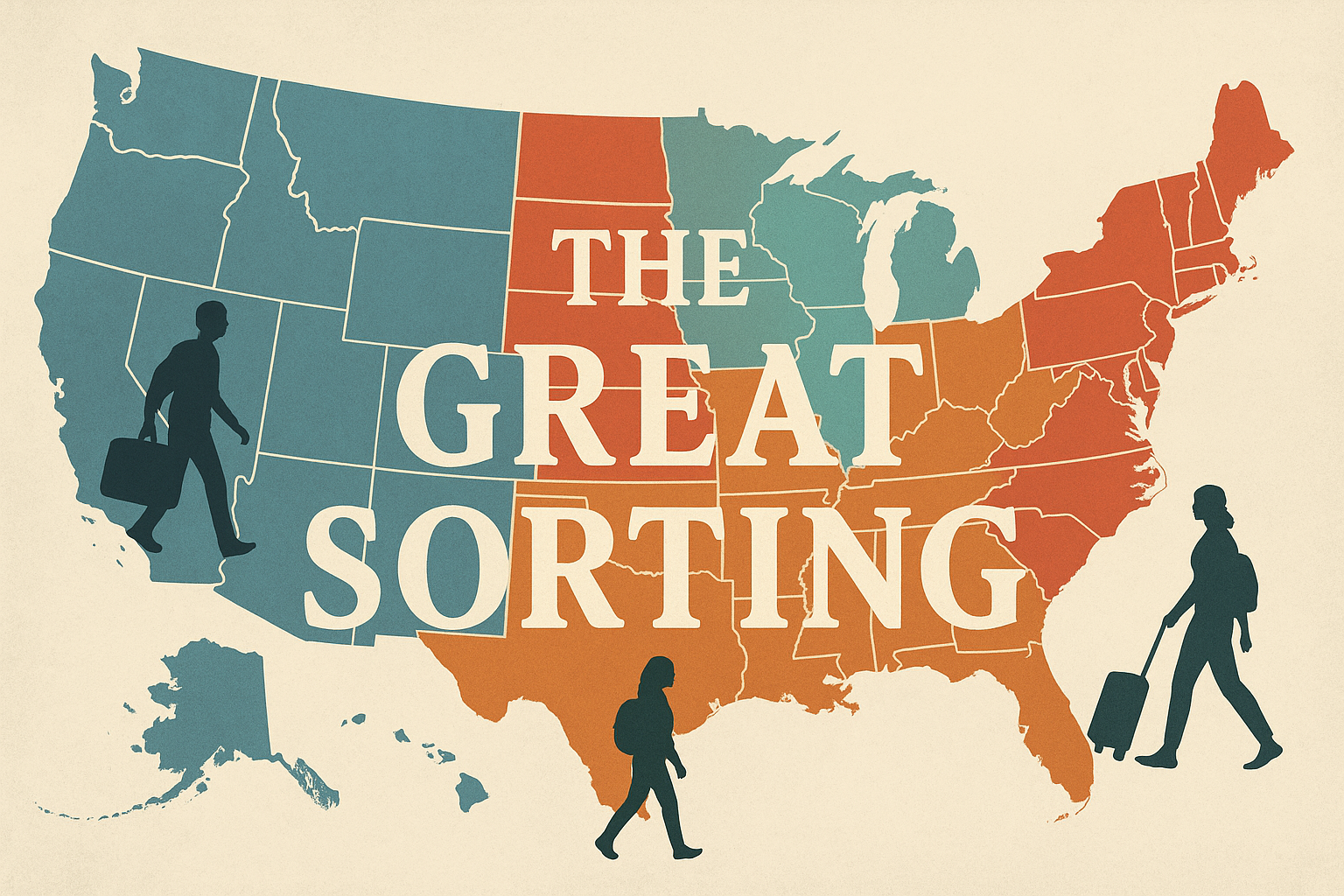
There are eras in a country’s life when movement feels almost unconscious, as if a million individual steps follow a private rhythm no one quite hears but everyone obeys. The United States has entered such an era. Roads fill. Apartments empty. Moving vans crawl across the interstate like patient beetles. A new interior migration is underway, and unlike the great movements of earlier centuries, this one has no official name. Yet anyone who has watched friends leave, or felt the pull themselves, knows what is happening. It is the Great Sorting, a quiet rearrangement of people and beliefs into new geographic clusters that are beginning to reshape the cultural topography of the nation.
The Machinery of Power
To describe the Sorting is to name a paradox at the center of American life. Millions of people are moving in order to feel safer, more aligned, more understood. They choose cities and states that reflect the values they hold dear. They choose climates that promise a future less battered by storm or smoke. They choose neighbors whose yard signs and bumper stickers do not raise their blood pressure. In short, they choose to curate their surroundings in a world that increasingly feels beyond anyone’s control. Yet, in doing so, they express a fundamental Acquiescence
The trouble is that the country cannot function as a single nation of a thousand isolated experiments. A democracy requires some shared sense of fate. It requires a belief that the future of people who are not like you is tied to your own. The Sorting weakens that feeling. It encourages the idea that one can retreat into a pocket of harmony and seal out the national storm. But storms travel. Markets travel. Policies travel. Grievances travel. No community, no matter how ideologically consistent, can insulate itself forever.
The Frontiers of Resistance
The most painful irony is that the Sorting is not driven by cruelty. It is driven by longing. People long for safety, for stability, for a sense of belonging. They long for a climate that supports life rather than threatens it. They long for political life that does not demand constant vigilance. These are not unreasonable desires. They are the desires of human beings in an era that feels increasingly precarious.
The Economics of Power
To understand the Great Sorting, then, is to understand the geography of fear and the geography of hope. It is to recognize that people are carving out new homelands in order to feel less alone. It is also to recognize that this process carries a cost the country has not yet fully reckoned with.
The Strategy of Disorder
The question facing the United States is not whether the Sorting can be stopped. It cannot. Climate change will continue to re sculpt the physical world. Political divisions will continue to exert their gravitational pull. People will continue to seek havens. The real question is whether the country can find ways to stitch connections across these new divides. Can it build institutions that span regions with radically different realities. Can it foster communication that is not rooted in contempt. Can it rediscover a national identity that does not erase difference but does not surrender to it either.
The Performance of Dominance
Perhaps the answer lies in remembering that movement has always been part of the American story. Families crossed prairies, mountains, and borders in search of better possibilities. The Great Sorting is another such movement, though its motivations are more anxious than hopeful. Still, even anxious migrations can lead to renewal if people carry with them a willingness to see others not as strangers but as part of the same unfolding experiment.
The Dialectic of Control
The danger is not that Americans are moving. The danger is that they are giving up on the possibility of a shared future. A country that forgets its interconnectedness becomes a country of fortified islands. Its people learn to defend their boundaries rather than expand their sympathies.
The Machinery of Consent
But a country that remembers its interdependence can find new ways to live with diversity, even if that diversity is now expressed more through geography than neighborhood. It can build shared infrastructures that link disparate regions. It can develop a political language that recognizes fear without inflaming it. It can honor the right of individuals to seek safety while still insisting that the national project requires a sense of mutual responsibility.
The Instruments of Fear
The Great Sorting is not the end of the American story. It is a chapter. It reveals how deeply people yearn for coherence in a time that feels fractured. It reminds us that the choices we make about where we live are never private. They ripple outward. They shape the emotional and economic landscapes of a vast country still searching for its next form.
The Production of Ignorance
If we attend to those ripples, if we refuse to surrender to fatalism, if we insist on the possibility of connection across the widening distances, then the Sorting may yet become something other than a retreat. It may become a reimagining of national life from the ground up. It may teach us that even in a fragmented geography, a republic can endure, not because its citizens agree, but because they remember they belong to each other.