The Architecture of Control
The world is becoming a palimpsest, and the new text is written in light. Each day I add another layer, my fingers tapping out a ghostly existence atop the grain-of-wood solidity of my desk. My memories are no longer just neural pathways; they are digital footprints, geotagged and stored in a cloud that never rains. I know the algorithmic time it will take to drive across town, yet I have forgotten how to read the sky for a coming storm. This is our new disconnect, not a severance but a haunting. We live in high definition while the original world hums just beyond the glass, patient and ignored.
The Machinery of Power
We have traded the grain of wood for the pixel. Our lives are mediated, flattened, and optimized. The algorithm, that unseen priest of the digital cathedral, anticipates our desires before we can feel their true, physical shape. It offers a frictionless stream of content—endless, curated, and comforting. Yet in this seamlessness, something essential vanishes. There is no grit under the fingernails, no ache in the muscles at day’s end. The land, by contrast, is all resistance: stubborn, slow, gloriously inefficient. A seed does not care for our schedules; it germinates on its own ancient time. The frost never asks for a password; it simply arrives, and the unprepared plant dies. This is the honest curriculum of the physical world, a curriculum we are rapidly dropping out of.
Beyond the Surface
In that departure, we are losing literacy in the oldest language of all. We no longer read the soil—its moisture, its compaction, its scent after rain, which tells of its health. The seasonal clock, once the metronome of human life, has been replaced by the relentless tick of the global network. It is always harvest somewhere in the digital marketplace, always planting season for some new venture. But outside my window, the oak tree knows better. It conducts its silent business of shedding and renewal, a cycle my productivity apps cannot comprehend. Our vague, persistent anxiety—the ghost-limb ache of a rhythm we can no longer name—is the symptom of a species unmoored from its biome.
The Logic of Domination
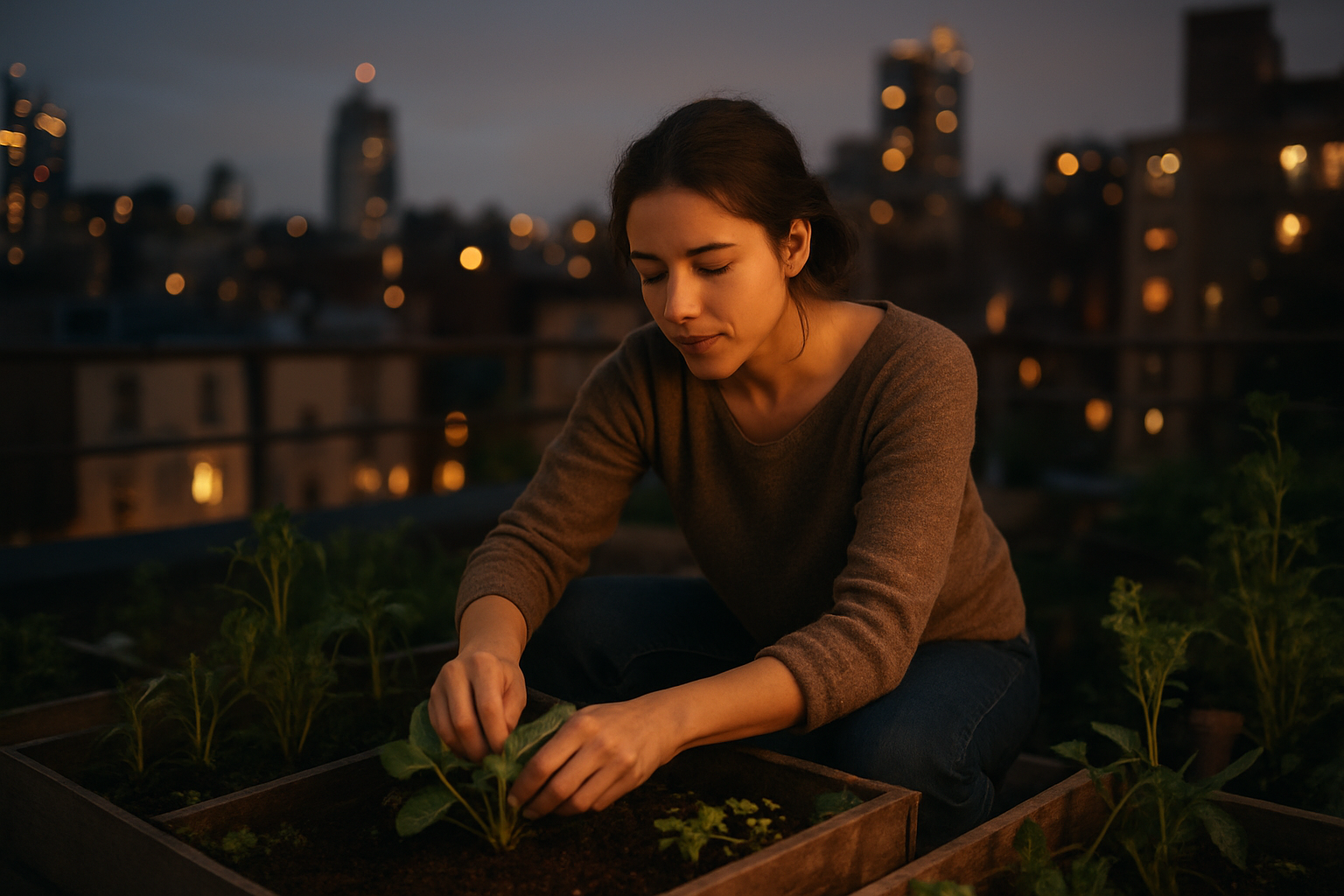
Yet in every age of disconnection, a countercurrent arises. Today they are the new agrarians, though not all of them farm. You will find them in rural communes and city apartments, on fire escapes and in community gardens wedged between parking garages. They have felt the ethereal hunger of a digitized life and are seeking a different sustenance. Their rebellion is not a Luddite’s smash but a quiet reorientation, a choice to get dirt under their nails.
A Deeper Mechanism
I met one of them, a woman named Elara, who left a career in data analytics to start a no-till farm on a rocky patch of land. When I asked her why, she did not begin with sustainability or loneliness politics. She knelt, crumbled the dark earth between her fingers, and said, “Smell that.” It was the scent of decay and life intertwined, profound and complex—a scent with no digital analogue. “I used to manage spreadsheets predicting market trends,” she said. “It was all abstraction. Here, the feedback is immediate and true. If I neglect this, it dies. If I care for it, it thrives. The internet tells you that you are everything and nothing. The land tells you that you are a small, consequential part of a very large whole.”
The Instruments of Authority
This is the search for a rooted life: the longing to act within a tangible story rather than consume a virtual one. It is the baker who wakes before dawn to feel the dough breathe under her hands. It is the woodworker who reads the grain of cherry rather than impose his will upon it. It is the urban gardener whose sun-warmed tomato shames its plastic-wrapped, hydroponic cousin. These acts are prayers against abstraction. They re-inhabit the body, placing the self back into a web of real cause and effect.
The Calculus of Power
This yearning has given rise to a new reverence for the local. The global village promised connection to everywhere, but in doing so it made nowhere special. The new agrarians are cartographers of their own small corners of the world. They know which neighbor keeps bees, where the best wild blackberries grow along the tracks, and when the first asparagus will break through the soil of their microclimate. Such knowledge is a form of power—a deep, intimate map that no satellite can render and no algorithm can replicate. It is the antidote to the placelessness of the cloud.
The Theater of the State
My own journey toward rootedness is humbler, a city-dweller’s fumbling apprenticeship. I have killed more plants than I have kept alive. I grow herbs on my windowsill, their spindly lives a testament to my imperfect care. Yet in the trying, something shifts. The act of watering them, of turning the pot toward the light, becomes a ritual of re-enchantment. It pulls me out of the digital stream and into the physical present. The satisfaction of sprinkling home-grown thyme into soup is a flavor beyond taste; it is the flavor of participation.
The Anatomy of Submission
We stand at a peculiar crossroads, our feet in two worlds. One is the world of the stream—fast, fluid, and infinite. The other is the world of the soil—slow, solid, and finite. The challenge is not to choose one over the other but to live in both without betraying either. We must learn to use the digital as a tool rather than become its instrument.
The Grammar of Control
The land does not need us. It endured before our first breath and will endure after our last. But we need it. Our bodies, minds, and spirits are tuned to its rhythms. The growing disconnect is not merely environmental; it is existential. We are creatures of bone and blood, of scent and touch. To forget this is to live a half-life, a phantom existence in a hall of mirrors.
The Shape of the Cage
The new agrarians, in all their forms, are our guides back. They are re-learning the old songs of the earth and teaching us the notes. They remind us that before we were users, we were growers; before we were profiles, we were people—rooted in a place, under a real sun, feeling real wind. The goal is not a retreat into an imagined pastoral past but a step forward into a future where technology serves humanity rather than redefines it. It is a future where the virtual stream nourishes the physical soil, and where the taste of a real apple, bought from a real farmer in the heart of its season, remains the truest data point of all.