The Architecture of Control
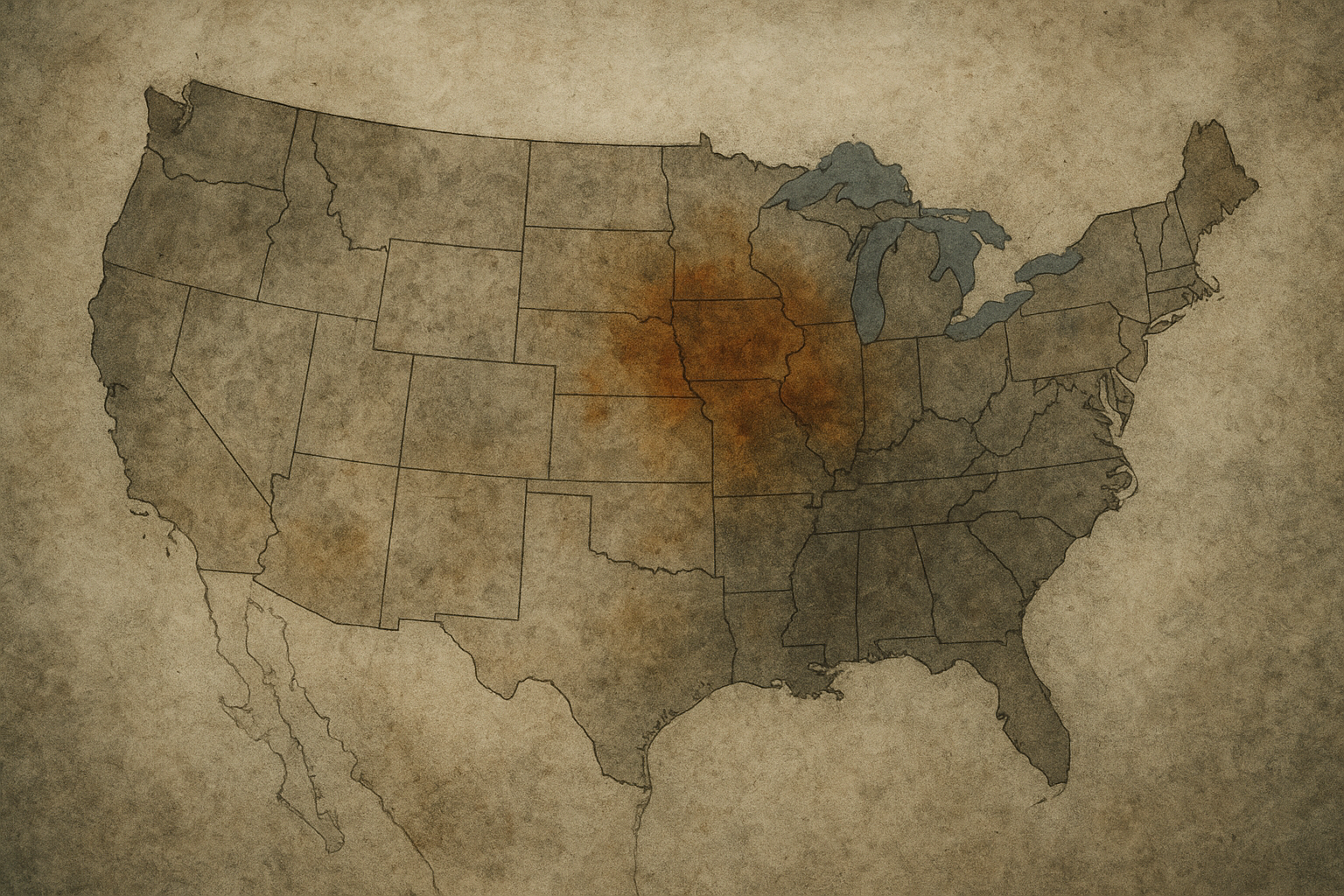
There is a map of America that is not printed on any glossy paper—a cartography that refuses the bold, confident lines of highways and state borders. This map is drawn in subtler inks: the silver of rust, the gray of ash, the brittle yellow of a forgotten field. It is a palimpsest of loss, etched not by cartographers but by the slow, patient hand of erosion. To read it, you must learn to see the negative space—to hear the silence pooled in the hollows left behind. This is the geography of grief, a national topography written in absences.
The Machinery of Power
I begin in the Rust Belt, in the cathedrals of a departed god. The factories here are our secular ruins, their steel skeletons bleached by sun and neglect. Their windows are a thousand sightless eyes. Step inside, and the air is thick with a silence that has weight and texture—the inverse of the roar that once lived here. This is where the great machines fell silent, and the quiet that rushed in to fill the void was not peaceful but hungry.
Beyond the Surface
You can still find ghosts here, if you know how to look. They are not specters in sheets but memories held in the bodies of aging men who stand at diner counters, their hands—once capable of calibrating a millionth of an inch—now tracing the rim of a coffee cup. This grief is for a future that was promised, a solidity that turned to vapor. It is the loss of a world where a man’s strength and sweat were a currency that could mortgage a life—a small house, a child’s chance. The grief here is not a sharp, clean cut; it is a slow, internal bleeding, a rusting from the inside out. Even the land seems to sag under the burden of it, the very soil mourning the passing of its purpose.
The Logic of Domination
Then, travel west—to the great basins and plains, where a different kind of elegy is being written in the dust. The grief here is elemental: a divorce between the earth and the sky. The soil is cracked into a million parched mouths, gasping for a rain that does not come. The sun, once a giver of life, is now a tyrant, bleaching the bones of barns and the hopes of a fifth generation.
A Deeper Mechanism
I walked through an almond grove in the Central Valley where trees were being ripped from the earth, their gnarled roots rising from the dirt like the ribs of a leviathan. This is a generational grief—the unspooling of a story that began with a homesteader’s stubborn hope, and now ends with a bank’s foreclosure notice. The land is not merely dying; it is becoming a stranger to those who loved it. This loss is a quiet, relentless suffocation. You can hear it in the wind that whips across the fallow fields—a sound less a whisper than a sigh from the planet’s core. It is the grief of a broken covenant, the terrifying realization that the ground beneath your feet—the one certainty you possessed—is no longer trustworthy.
The Instruments of Authority
And then there are the Appalachian hollows, where grief is a pharmacology—a sweet, deadly poison administered in small, white pills. This loss is intimate, a virus in the bloodstream of a community. It hollows out not just buildings but people. You see it in houses with boarded windows, in playgrounds that are too quiet, in the faces of grandparents raising their children’s children. The grief here is a thief that steals futures in the present tense.
The Calculus of Power
It does not come as a single, catastrophic event, but as a slow-motion collapse—a town disappearing one person at a time. I sat in a community center that was once a vibrant church, where the stained-glass Jesus now looked down upon a circle of folding chairs and shared stories of relapse and recovery. The grief here is layered with anger and shame—a toxic sediment that makes it hard to breathe. It is the cruel realization that the very thing promising relief from the pain of economic oblivion became the mechanism of a deeper destruction.
The Theater of the State
These three landscapes might seem discrete—the rust of the factory, the dust of the farm, the pharmaceutical crack of granite.
The Circulation of Authority
The geography of grief is not a final destination. It is a contested territory—the field upon which our national soul is being fought over. To ignore this map, to pretend the contours of this loss are not real, is to ensure we remain lost within them. But to learn its lines, to trace its valleys and eroded slopes, is to begin a different kind of navigation.
The Instruments of Consent
It is to understand that before there can be rebuilding, there must be a long, unflinching look at the ruins. And in that looking—in that shared acknowledgment of what has been lost—we might just find the first, fragile seed of a new language, one capable of singing a future out of the silence.