The Architecture of Control
The Mediterranean has always carried the ambitions of others across its surface. Centuries ago it bore Phoenician galleys and Roman triremes. Today it carries a quieter fleet. Underwater, in the dark where sunlight cannot reach, submarine cables pulse with signals and electricity, tying continents together in threads of intention. The newest of these threads is called Elmed. On paper it is a high-voltage direct current link between Sicily and Cape Bon, two hundred kilometers of promise connecting Europe and Tunisia. From above it resembles a bright, confident stroke on a map. But in Bassem’s apartment in Tunis, where the fan slows and stutters in the August heat, it feels less like a bridge and more like a tether.
The Machinery of Power
The language surrounding Elmed is polished and reassuring. Officials speak of mutual benefit and global decarbonization. Europe will import sunlight. Tunisia will gain foreign currency and a symbolic foothold in a green future. Yet the vocabulary of development is rarely as new as it pretends to be. Every glossy declaration of partnership rests upon older texts written in the ink of dependency. Scratch the surface of the words “win-win” and the familiar script of “green colonialism” begins to show through. This is not the colonialism of gunboats and governors. It is the colonialism of loans, leverage, and contracts signed far from the places they transform.
Beyond the Surface
Tunisia carries the weight of external debt like a chronic ache. The Elmed project adds another pull on that already strained muscle. The loans come largely from European development banks and the World Bank. They arrive with strict conditions and polite expectations that are difficult to refuse. The project is not a gift. It is a purchase. And the cost will be carried by a national economy that has little breath left to give.
The Logic of Domination
The target of this pressure is more than an institution. It is a symbol. For decades, the Société Tunisienne de l’Electricité et du Gaz, known simply as STEG, has been a cornerstone of the post-colonial loneliness/”>social contract. It provided subsidized electricity and stable work. It offered Tunisians a sense that essential resources could be managed by the public for the public. My friend Bassem grew up under that promise. His grandfather, Mahmoud, embodied it.
A Deeper Mechanism
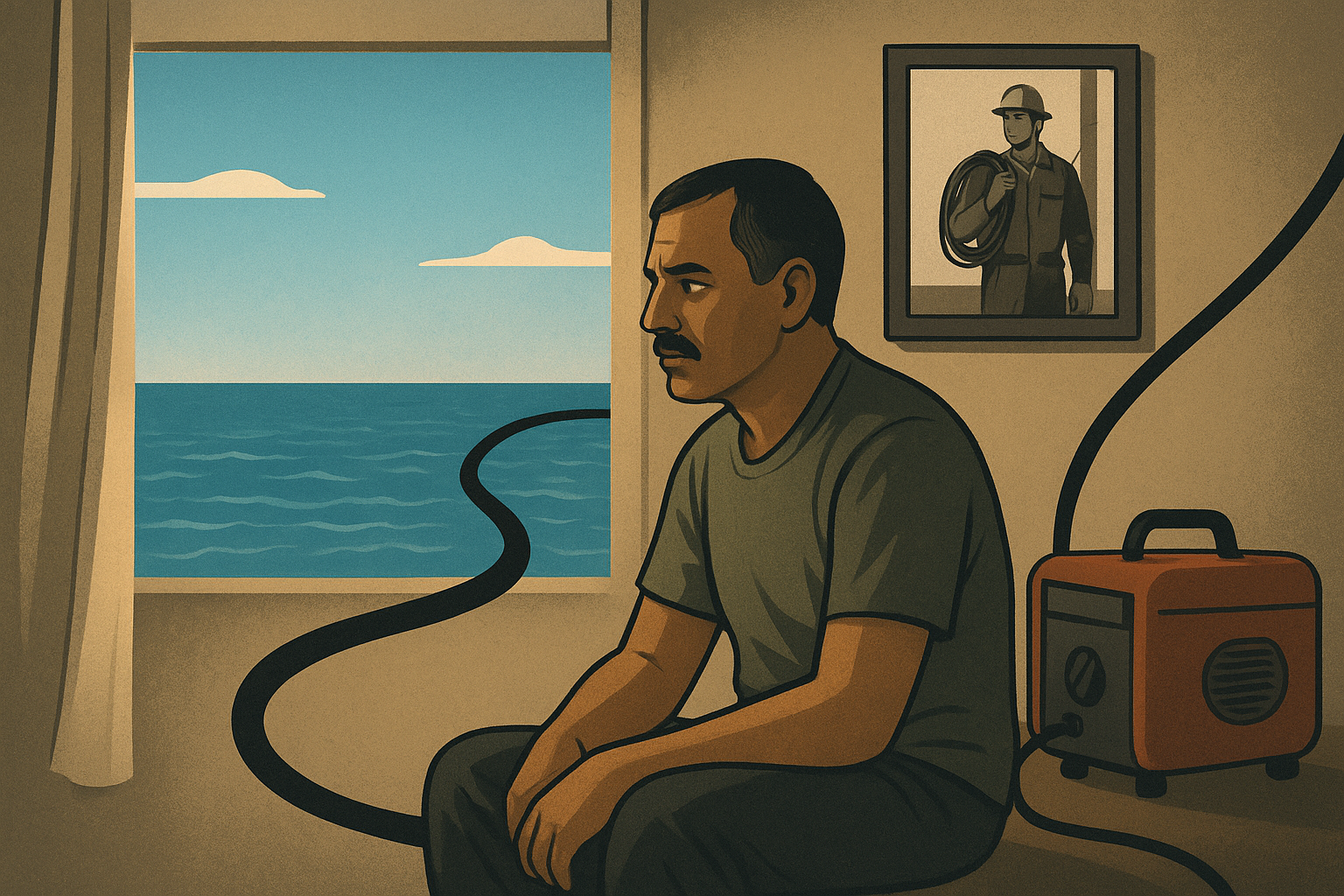
Mahmoud spent forty years working for STEG. In a framed photograph that hangs in his living room in Ariana, he stands beside a newly erected utility pole. A coil of cable rests on his shoulder. His posture is both proud and shy, as if he understands that he is part of something larger than himself. Bassem once told me that as a child he believed his grandfather could hear electricity move. Mahmoud used to say that every neighborhood had a particular pulse. A good technician could sense when a transformer was uneasy, the way a doctor places a hand on a patient’s chest and listens for trouble.
The Instruments of Authority
The Elmed project threatens to undo the world Mahmoud helped build. STEG’s share of national electricity production is projected to fall sharply, not through innovation or competition, but by deliberate policy design. Private companies, often European energy giants, will generate an increasing portion of Tunisia’s power. STEG will be reduced to a distributor, a conduit through which other entities’ electricity flows. The institution that Mahmoud served with such fidelity will become a toll collector guarding a highway it does not own. It is a quiet erosion of sovereignty, carried out through spreadsheets and procurement frameworks rather than force.
The Calculus of Power
Tunisia receives more than 3,000 hours of sunlight each year. Its deserts glitter with potential. Yet it remains energy poor, producing less than half of the electricity it consumes and relying heavily on imported gas. The hope sold to the Tunisian public was that Elmed would allow the country to export the solar abundance it cannot yet harness. But as the design evolved, a more complicated truth emerged. The cable is now structured to allow power to flow in both directions. It enables Italy to send its surplus southward when wind farms overproduce or solar plants flood the grid with more energy than it can absorb. Tunisia becomes a pressure valve for European volatility.
The Theater of the State
This inversion carries real costs. The electricity moving through the cable will be priced in euros. Tunisia’s dinar, vulnerable to market swings, will be tied to the rhythms of an economy it cannot influence. A cold winter in Milan or a booming manufacturing quarter in Munich could raise Tunisia’s energy bill overnight. Early estimates suggest that the country may lose more than two hundred million euros in hard currency during the project’s first decade. The language of partnership cannot disguise the imbalance. Tunisia becomes dependent not only on another grid, but on another currency.
The Anatomy of Submission
The consequences are not abstract. They echo through Bassem’s apartment each time the fan falters and the room grows still. They haunt the memory of Mahmoud’s era, when a national grid was imagined as a shared shield against scarcity.
The Grammar of Control
I sometimes think of that photograph of Mahmoud. The utility pole behind him stands like a promise, a declaration that the country could build and maintain its own infrastructures. Today that image feels endangered. It fades beneath the shadow of loan agreements drafted in distant boardrooms. This is how sovereignty weakens in the modern age. It does not collapse. It is signed away, small clause by small clause.
The Shape of the Cage
Yet the alternative is not isolation. The sun, the wind, and the sea ignore borders. The real question is not whether Tunisia should connect to Europe, but on what terms. A just and sustainable future begins with strengthening what already exists. Imagine the billions of euros designated for Elmed redirected toward Tunisia itself. Picture public solar farms rising in the Sahara, where the sunlight is abundant and free. See a national grid modernized to carry that energy from desert to coast. Envision a renewable energy law rewritten to insist that domestic need is met before any export is allowed. Such a future does not reject connection. It insists on equality.
The Geography of Influence
This vision is not romantic. It is pragmatic. It extends the legacy of people like Mahmoud, who believed that sovereignty was not a grand abstraction but a daily practice carried out by workers who kept the lights on. It honors the intuition he developed over decades, his ability to sense when a neighborhood was straining against the limits of its own circuitry.
The Circulation of Authority
From Bassem’s balcony, the Mediterranean looks calm. A fisherman drives past on the street below. In the back of his van sits a battered generator. It is loud and inefficient, but when the evening blackout arrives, its power will be his to command. He will pull the cord, the engine will cough awake, and for a few hours the light will belong to him alone.
The Instruments of Consent
That small act carries a quiet truth. A nation’s future is shaped not merely by cables that cross the sea, but by the ability to decide what flows through them and for whom. Tunisia’s path forward lies in reclaiming that decision. Until it does, the current that binds will remain a current that controls.