The Architecture of Control
We worship at the altar of output. Our liturgies are sung in the key of push notifications and quarterly reports; our sacraments are caffeine and Adderall. We offer up our hours to the spreadsheet, our attention to the algorithmic feed, our rest to the insatiable god of Productivity. This deity demands not just our labor, but our leisure—now rebranded as “self-care,” an optimized pause to recharge the human battery for its return to the assembly line. To be productive is to be good, to be valuable, to be seen. To be unproductive is to be lazy, suspect, at risk of vanishing from the economy’s ledger altogether.
The Machinery of Power
This is the Cult of Productivity, the dominant civil religion of our age. Its gospel is growth, its hell is stagnation, and its promised land is a state of perpetual, frictionless efficiency. But as with any orthodoxy, it breeds its own heretics. In an economy that demands relentless optimization, the most radical rebellion is no longer a shouted polemic but a quiet, deliberate refusal. It is the pursuit of stillness, boredom, and unproductive time—not as lifestyle enhancement, but as an act of political and personal reclamation.
Beyond the Surface
I must first acknowledge the privilege of this proposition. The deliberate cultivation of boredom is a luxury not afforded to the single parent working three jobs or to anyone in acute survival mode. Yet the principle of temporal sovereignty—the right to control one’s own attention and time—is a universal right worth extending to all. My heresy begins from a place of relative security, but its logic applies to any sliver of time one can claim as one’s own.
The Logic of Domination
History, in its rhymes, shows that power has always sought dominion over time. The shift from peasant time—governed by the rhythms of sun and soil—to the regimented, bell-tolled hours of the early factory was not merely logistical; it was a violent seizure of temporal sovereignty. The peasant, though poor, owned their pauses, their idle chatter, their wandering attention. The factory worker’s time was purchased, parceled, and policed. Their body stood at the loom, but their mind—that unquantifiable, unproductive space—remained the final frontier of autonomy. To daydream on the clock was a small, secret rebellion.
A Deeper Mechanism
Today’s digital panopticon has completed this conquest, invading that last bastion. The smartphone is the factory bell we carry in our pockets, its chimes and buzzes a constant summons back to our duties as consumers and producers. The “attention economy” is a misnomer; it is an attention-extraction economy. Our focus is the raw material, and our unfocused, daydreaming minds are the untapped wilderness to be cleared and cultivated. In this context, to be deliberately still is to withdraw one’s consent from the entire system. It is to let a valuable resource lie fallow. It is, in its quiet way, a strike.
The Instruments of Authority
This heresy begins with stillness. Stillness is not rest. Rest is productive; it is sanctioned—mandated even—by the cult to prevent burnout and preserve long-term output. Stillness, in its heretical form, is purposeless.
The Calculus of Power
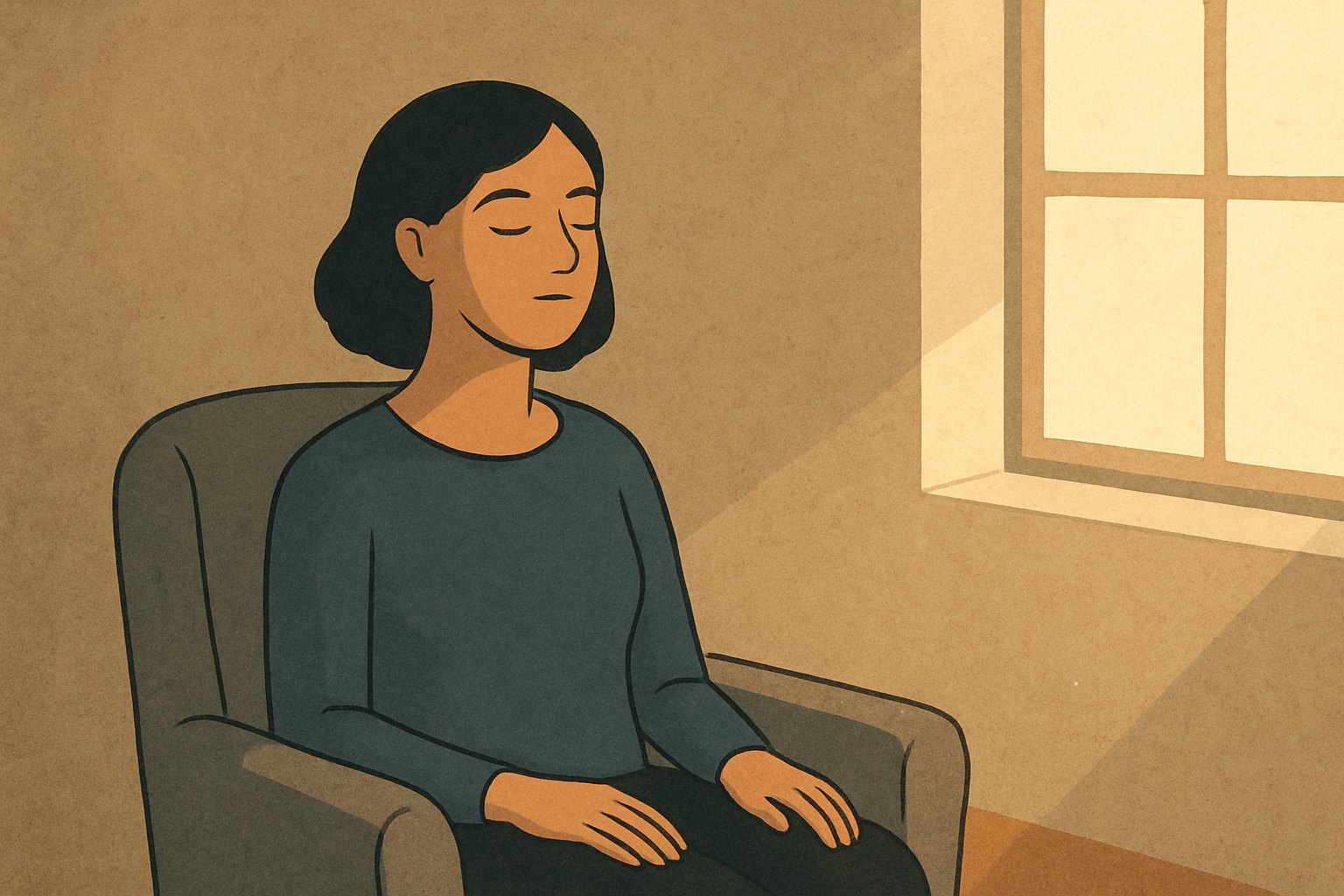
I learned this not through grand philosophy, but through a failure of nerve. Last Tuesday, I committed to ten minutes of it. I sat in a worn armchair, the late-afternoon sun stretching a long, lazy rectangle of light across the floorboards. I set no timer. For the first minute, it was peaceful. Then came the itch—not a physical one, but a cognitive fidgeting, a phantom limb twitching for a device. My mind became a frantic search party: Shouldn’t you be planning dinner? What about that unread email? The guilt was a palpable pressure in my chest. This, I realized, was the internalized voice of the orthodoxy, terrified of an unmonetized moment. But I stayed. I watched a dust mote dance in the sunbeam, a tiny, chaotic universe with no destination. And around minute six, something shifted. The search party disbanded. The static faded. I was simply there—aware of my breath, the weight of my body in the chair, the sheer, unproductive is-ness of the scene. I had done nothing, yet reclaimed a small, vital piece of my inner geography.
The Theater of the State
The French philosopher Simone Weil, no stranger to the dynamics of power and social value. It is learning a craft you will never monetize. It is spending an afternoon with a friend without turning it into “networking.” It is, in essence, the application of art’s logic to the whole of life—to do a thing for its own sake, for the sheer value of the doing, not its measurable outcome.
The Geography of Influence
Here the political dimension becomes unmistakable. The Cult of Productivity is a powerful instrument of social control. It pathologizes the unemployed, the underemployed, the disabled, and the elderly—those whose worth it cannot compute. It keeps the employed in anxious servitude, forever fearing they are not doing enough. To proudly, openly claim unproductive time is to spit in the eye of this value system. It is to assert that a human being’s worth is intrinsic and unassailable, not contingent on their weekly output. It is to stand in solidarity with all those the system deems “unproductive,” and to see in their condition not failure but a revelation of the system’s flawed accounting.
The Circulation of Authority
The rhymes of history echo here—from medieval monks who valued otium (contemplative leisure) over negotium (business), to the 1960s counterculture’s call to “drop out.” The powerful have always known that a population kept busy, distracted, and terrified of stillness is easy to manage. A citizen who can be alone with their thoughts, who is at home in the fertile void of boredom, and who derives meaning from unproductive acts is far harder to manipulate, and far more likely to ask dangerous questions.
The Instruments of Consent
This heresy is not a call for universal indolence. It is a call for rebalancing—for the recognition that the unproductive self is not a wasted self but a preserved one. It is the fallow field that, left untouched, regains its nutrients. It is the silence required to hear the still, small voice that knows what it truly wants, beyond what it is told to want.
The Architecture of Acquiescence
The Cult of Productivity has named its god, and we have been compelled to kneel. The heresy proposed here is simply the act of rising, stretching our underused limbs, and walking—without destination—into the vast, sacred wilderness of our own time. In that unoptimized space, in the stillness, the boredom, and the glorious, useless moments, we might just remember who we were before we were ever called to be productive. And in that remembering, we reclaim not just our time, but our very selves.