The Architecture of Control
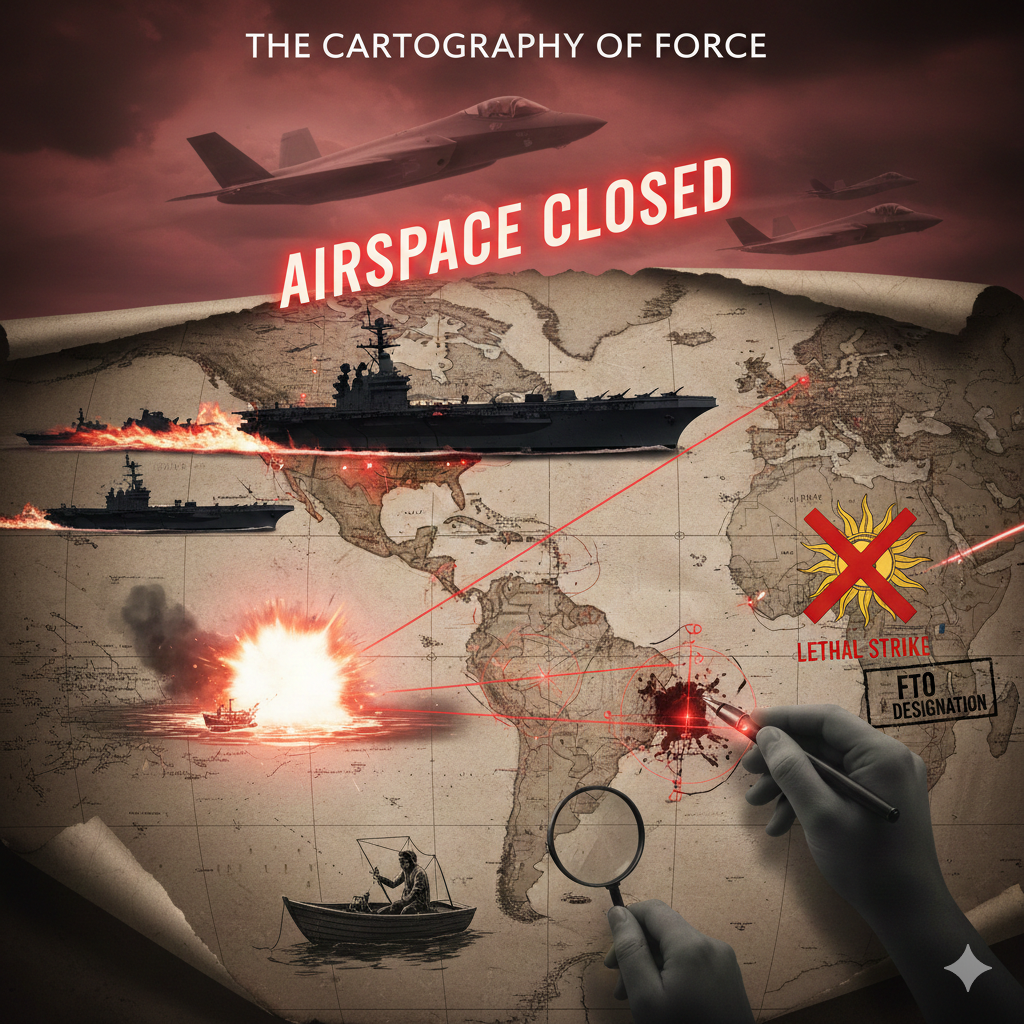
On November 12, 2025, a statement from the White House Press Secretary declared Venezuelan airspace “closed in its entirety.” It was not a notice to airmen (NOTAM) issued through the International Civil Aviation Organization, but a political fiat, broadcast to the world. That same week, grainy, declassified footage released by U.S. Southern Command showed a small boat—a “go-fast” vessel—vaporizing in a flash of light off the coast of Puerto Cabello. The Pentagon termed it a “lethal strike” against the “Cartel de los Soles.” These are not abstract tensions; they are dated, documented events. They are the first strokes in a new cartography of force, a map being drawn not on paper, but in the lived reality of a nation, using the pens of warships and the styluses of fighter jets. To observe this is to witness the oldest of stories retold: the lopsided architecture of justice when it confronts the monolithic fact of power. The “closure” of airspace is a performative act, a speech-act in the Austinian sense: it does something by saying something. It does not build a wall; it creates a condition. It says, Your sovereignty is now a conditional state, contingent on our tolerance. Caracas’s rejection is a necessary, ritualistic protest, the squeak of a mouse before a hawk, but it is also a claim to a different map, one the cartographers of force do not recognize. The subsequent designation of the “Cartel de los Soles” as a Foreign Terrorist Organization is the final act of re-labeling. It is the pinning of a specimen—a complex, human political entity—transforming a state into a syndicate, a president into a kingpin. The goal is not subtle; it is the old, familiar script of regime change, now dressed in the legalistic language of counter-narcotics and counter-terrorism.
Beyond the Surface
This brings us to the legal ballet, a spectacle where the lopsidedness of justice becomes a function of intellectual agility. The violations, as catalogued by international legal experts, are stark: the UN Charter’s prohibition on the threat or use of force; the principle of national sovereignty; the stench of extrajudicial execution from the maritime strikes. These are not technicalities; they are the constitutional sins of the post-war order.
The Logic of Domination
And yet, the powerful do not merely break the law; they metabolize it. The U.S. justification is a masterclass in normative reconstruction. The “war on drugs,” a failed domestic policy, is resurrected as an “armed conflict.” This linguistic pivot is everything. “Armed conflict” activates the Law of Armed Conflict (LOAC), a body of law designed for the battlefields of Fallujah. Suddenly, the legal machinery for interstate war is deployed against a boat. Lethal force is no longer assassination; it is a lawful military engagement. The FTO designation provides the second scaffold, framing aggression as counter-terrorism. The architecture of international law, intended to be a cage containing the beasts of war, is repurposed as a kennel, releasing them on a designated enemy. The law becomes a tool. Its application is a function of power.
A Deeper Mechanism
This leads to the deep, resonant echo—the ghost in the machine. The ghost of Iraq, where “weapons of mass destruction” were the pretext; the specter of Vietnam, where the Gulf of Tonkin incident served as the casus belli. We are walking a well-trod path paved with the rubble of nations shattered by disputed pretexts. The “double standard” is not hypocrisy; it is the structural reality. The powerful enjoy immunity woven into the fabric of the system they architected: the UN Security Council veto is the ultimate legal shield. The potential for domestic accountability, like Congress invoking the War Powers Resolution, is a flickering candle in a hurricane of executive authority, a mechanism historically rendered inert. The lesson is clear: the only court that truly matters for a superpower is the court of domestic opinion, and it is often a lenient judge.
The Instruments of Authority
But why Venezuela? Why this particular crisis, now? The answer is not in the universal, but in the specific: in its vast oil reserves, its strategic location, its role as a node of regional resistance to U.S. hegemony. It is a case study, yes, but one that reveals the particular logic of 21st-century power: not always outright annexation, but enforced compliance, the management of dissent through economic strangulation and military intimidation. To ask for a purely “Venezuelan perspective” is to risk a false equivalency in an asymmetrical confrontation, but it is to acknowledge that this is not an abstract debate. It is about the lives shaped by these policies.
The Calculus of Power
So, what are we to make of this act of mapping? The strikes on the boats are not just explosions on water; they are periods at the end of sentences passed without a trial. My earlier, lyrical question—What is the sound?—now feels uncomfortably aesthetic. The sound is irrelevant. What matters is the silence that follows: the silence of the fisherman’s family, the silence of a legal system bypassed, the silence of a world that has seen this before. The closure of airspace is felt by the air traffic controller in Maiquetía, watching the unchallenged blips of foreign aircraft on his screen, his headset filled not with requests for entry, but with the static of his own imposed irrelevance.
The Theater of the State
The lopsidedness, then, is not a flaw in the system; for the powerful, it is the system. It is the privilege of writing the rules, of interpreting them, and of exempting oneself.
The Anatomy of Submission
What would genuine justice look like? Not a naive utopia, but a system where the mechanisms of accountability are not neutered by veto power, where the Law of Armed Conflict is not a convenience to be activated but a constraint to be universally observed, where sovereignty is not a privilege of the strong but a right of the weak. The obstacles are not mysterious; they are the very structures of power this essay describes.
The Grammar of Control
The ending of the previous draft—“We, in our silent acquiescence, become its sharpened point”—risked melodrama. The truth is more complicated. The “we” is fractured. It includes me, writing this in the safety of a study, using the language of the powerful to critique power. It includes the citizen who feels powerless against the machinery of the state, and the journalist who reduces the crisis to a headline. Our acquiescence is not always silent; sometimes it is a murmur of dissent that fails to coalesce into a roar. The point is not that we are the sharpened tip of the spear, but that we are the ground on which the cartographers walk, the medium that accepts the lines they draw. The challenge, then, is not merely to recognize the map, but to refuse its legitimacy, to scribble in the margins, to propose a different, more humane geography altogether. It is a quixotic task, but the only one that offers an alternative to the same old, ruinous lines.