The Architecture of Control
We were promised a single map. A sleek, digital Mercator where borders softened into connective tissue, where capital and goods coursed through bright, uninterrupted arteries. This was the animating dream of globalization: that old empires and ideologies would give way to the gentler logic of markets; that interdependence would bind us so tightly that conflict would become inefficient, even irrational. We were to become citizens of everywhere, our national attachments diluted by shared supply chains and shared prosperity.
The Machinery of Power
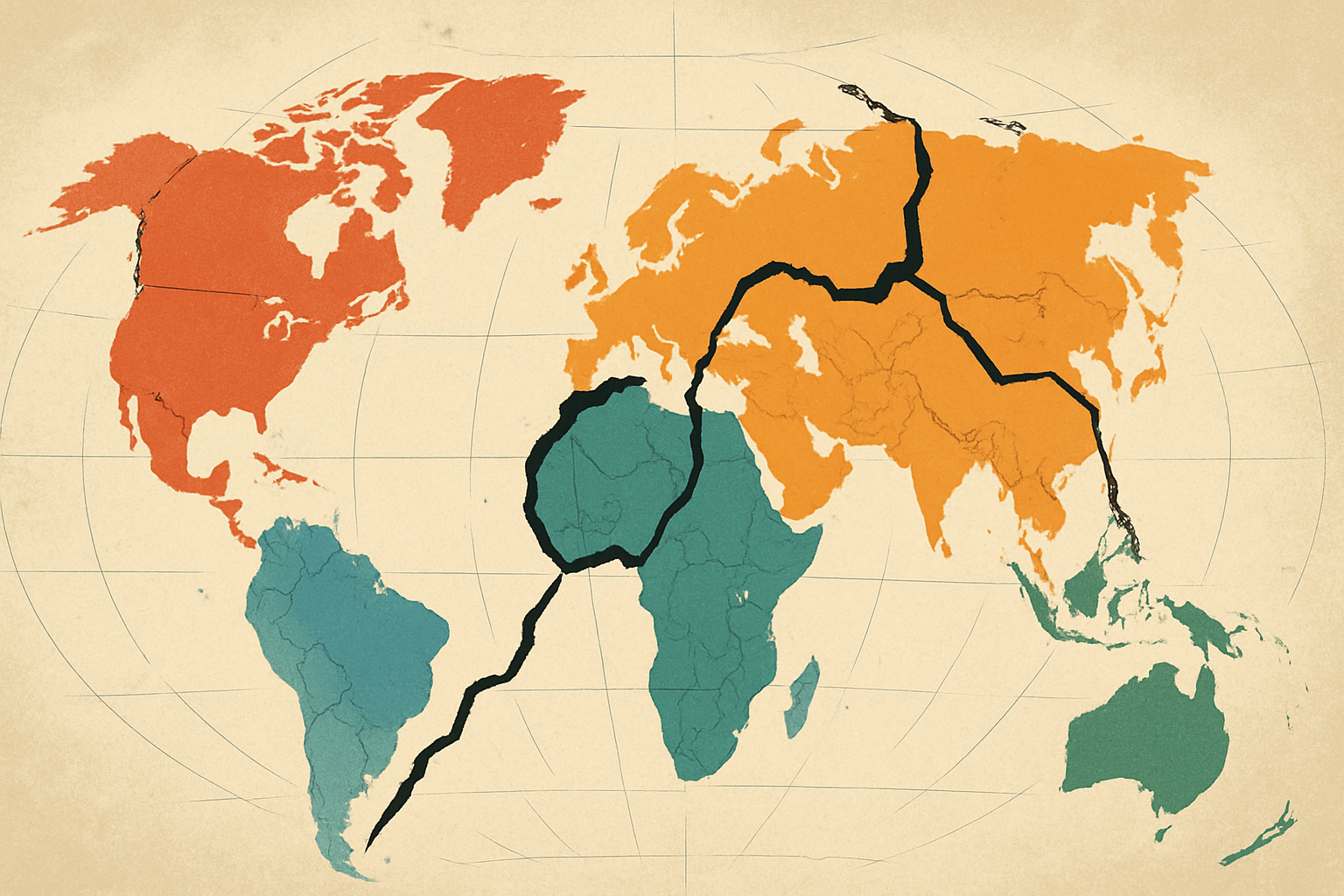
But we—children of that imagined integration—have become the cartographers of its undoing. We are drawing a new atlas, etched not by convergence but by strategic divergence, not by dissolving borders but by the deliberate construction of new ones inside the very systems meant to erase them.
Beyond the Surface
To call this moment “deglobalization” is to mistake the scale. That word implies collapse, a sudden extinguishing of the world we built. What we face instead is geological: the slow, grinding drift of tectonic blocs. The continents do not disappear; they rearrange themselves into a more precarious geography. Trade does not vanish; it reroutes along fault lines carved by fear and competition. The age of optimizing exclusively for efficiency—the just-in-time dream linking a factory in Shenzhen to a doorstep in Ohio—has yielded to an age that optimizes for strategic resilience. The new organizing principle is the mitigation of vulnerability.
The Logic of Domination
You can feel this shift in the material world, in objects that once seemed apolitical. Recently I held my smartphone and realized its seamless surface concealed a deeper fracture. The chip, once almost certainly from Taiwan, now came from a friend-shored fab in Arizona. The rare earths inside it, formerly processed almost exclusively in China, now carried documents certifying a more politically acceptable journey through Australia. I was holding a device constructed not for maximum efficiency but for minimizing geopolitical exposure—a product of strategic anxiety.
A Deeper Mechanism
The pandemic made this visible in brutal fashion. Essential goods—painkillers, ventilator parts, the silicon conductors powering modern life—were concentrated in a handful of regions. We learned that our pharmacological survival hinged on a few chemical plants in Asia. The global response has been an enormous and expensive unraveling. “Re-shoring” and “friend-shoring”—sterile neologisms for something far more consequential—signal the re-politicization of production. Nations are not merely building new factories; they are building duplicate ones, mirror images meant to ensure that if one bloc is cut away, the other can still function, still compute, still breathe.
The Instruments of Authority
The cost of this realignment is a kind of collective anxiety tax. The hyper-efficient global model was a wager on perpetual openness. That wager has failed. Resilience is now the deity we serve, and its temples are redundant fabs, expanded stockpiles, and warehouses filled with insurance against tomorrow’s adversaries. Logistics—once an unglamorous back-office function—has become a front line, each node a potential vulnerability, each shipping route a geopolitical decision.
The Calculus of Power
If the fragmentation of trade is a reordering of the world’s limbs, the fragmentation of finance is a break in its circulatory system. For decades, the U.S. dollar functioned as the planet’s bloodstream. To weaponize it—as the United States did by cutting Russia from the SWIFT network—was to demonstrate extraordinary crisis could trigger coordinated central bank action. A famine or pandemic could elicit multinational mobilization. Fragmented worlds do not respond; they calcify.
The Grammar of Control
As capital splinters into smaller channels, crises will ricochet rather than diffuse. The very idea of a “global community” capable of addressing climate change, pandemics, or financial contagion becomes increasingly implausible. Cooperation requires trust, and trust is dissolving along the same lines that divide supply chains and currencies. How does one negotiate a carbon treaty when each bloc views the atmosphere itself as another contested resource?
The Shape of the Cage
We, the new mapmakers, are charting this shifting terrain as best we can. The old map—its glowing nodes, its optimism of connection—is obsolete. The new one is drawn in hesitant strokes, its borders shifting with each technological breakthrough and each political rupture. It is a map drafted not in ink but in pencil, smudged by fear and contingency.
The Geography of Influence
What we are witnessing is the quiet end of an era, the fading of a belief that the world would inevitably grow more interconnected, more cooperative, more stable. Our compass now swings toward sovereignty, redundancy, and security. The journey ahead is not a march toward shared horizons but a navigation of rival orbits, each pulling against the other, stretching the world into thin, vibrating tension.