The Architecture of Control
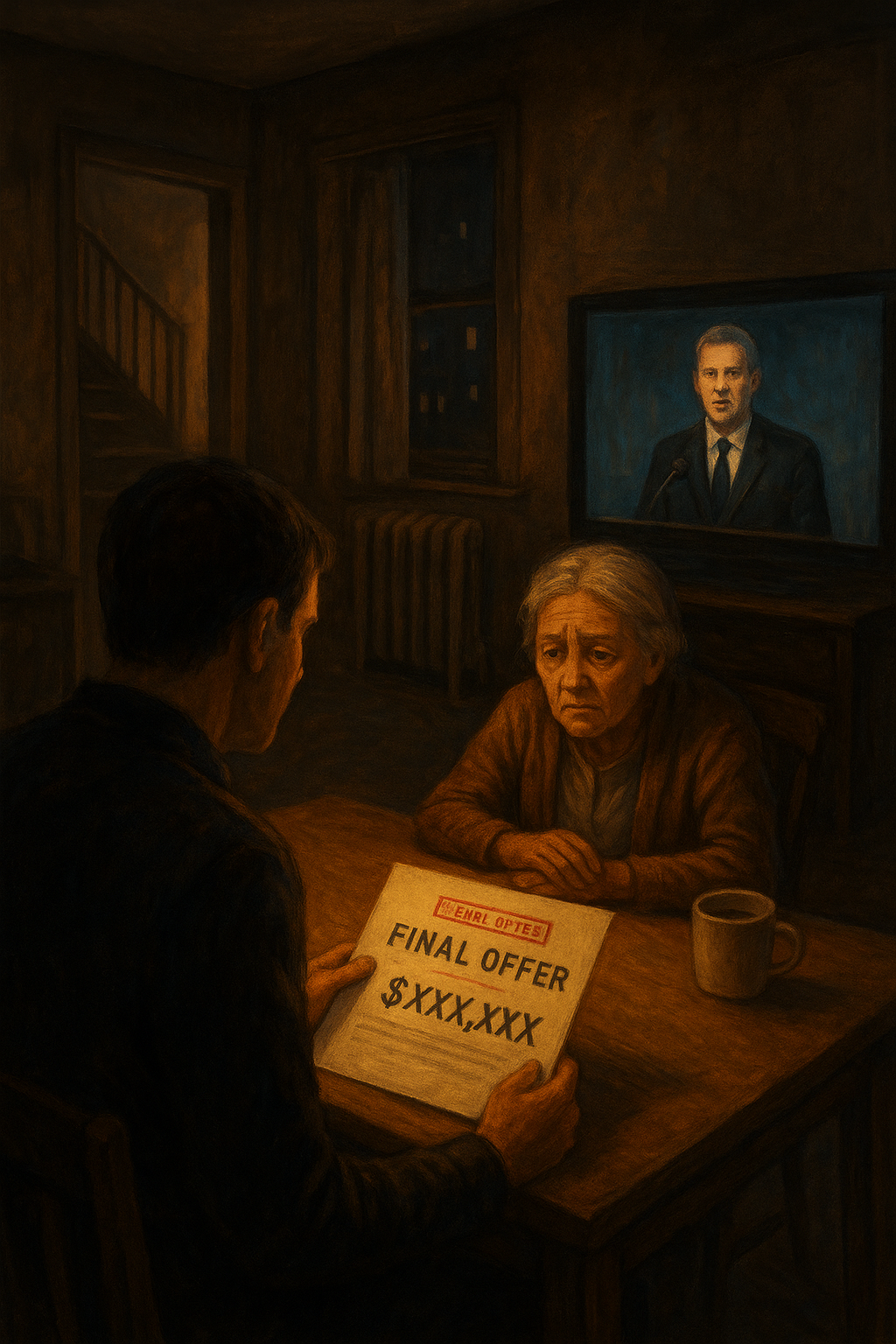
The envelope slid under my door just after noon… thick, official, the kind of paper that smells faintly of machine oil and certainty. It wasn’t addressed to me, but to my landlord, Mrs. Gennaro. Her name looped in blue fountain pen ink. She stood in the hallway, her hand trembling, a small woman wrapped in an old cardigan.
“For you,” she said. “You understand these things.”
The Machinery of Power
Inside was an offer: sleek, almost polite in its predation, to purchase the three-decker she’d inherited from her father. The number glinted like metal. I watched her eyes move over it and then away, as if staring too long might turn her to salt. This, I thought, was the real city: not the one of polished oak and ribbon cuttings, but a map drawn in the invisible ink of capital. Its skyline rose not from stone but from contracts, its architects working in air-conditioned rooms no tenant would ever enter.
Beyond the Surface
That night, the mayor’s face filled my television. He spoke in the practiced rhythms of crisis and renewal. But if you listened past the cadence, you could hear the machinery underneath, the hum of a different engine, one that runs not on hope, nor votes, but dividends. The politicians are gargoyles on this edifice: expressive, theatrical, and designed to channel public fury away from the foundations. We rage at the rain while the architects of the watershed, finance and real estate, fused like steel, remain dry in their glass towers. The spectacle keeps us busy, a curated storm that drowns curiosity about who owns the sky.
The Logic of Domination
To live with that awareness is to feel a cage tightening, though its bars are made of perception. Every gesture begins to look choreographed, every policy a script. It is tempting, then, to surrender to that exhaustion, to believe history is a sealed train on a fixed track, and every call for change just the whistle of a doomed engine. This is the elegance of fatalism: it asks nothing of us but disbelief. It collapses the difference between a hard-won reform and a cosmetic concession. It lulls us into the idea that to see clearly is to stand still.
A Deeper Mechanism
My friend Leo couldn’t bear that stasis. Once a brilliant organizer, he left for Vermont to grow heirloom tomatoes and make decisions by consensus. His photos are luminous… his son knee-deep in soil, the sky wide and clean. But the deed to his land still lives in a courthouse drawer, its value rising and falling with the market he fled. His retreat, however principled, is also a kind of surrender. The system does not mind its critics leaving the building; it only fears them rearranging the furniture.
The Instruments of Authority
In that space between the lie of the stage and the suffocation of the cage, I find the power elite, an interlocking organism of boardrooms, generals, and cabinet offices. Yet Mills was no fatalist. He saw fissures in the organism, tensions, rivalries, small cracks where leverage might take hold. And he offered a tool: the sociological imagination, that act of translation between personal trouble and public issue.
The Calculus of Power
To think this way is to turn isolation into connection, pain into pattern. Mills demanded that we see the machinery with unflinching clarity, but refuse to bow before it.
The Theater of the State
I take the envelope from Mrs. Gennaro again. It feels cold, its edges too clean. This is the architecture I inhabit. To be naïvely idealistic is to believe a speech at city hall can halt the tide. To be wholly cynical is to tell her to take the money and run. The third path, the Millsian one, is harder: to survey the shadow, to measure its dimensions, and then to press, patiently, where it thins.
The Anatomy of Submission
So I make a copy of the letter. I knock on my neighbors’ doors.
At Mrs. Gennaro’s kitchen table, the Formica cool beneath our wrists, we begin the small work. Carla wants to call the councilor; Jamal warns the city code will crush us; Mrs. Gennaro pours coffee that tastes faintly of burnt sugar. I spread the copy flat.
“We have to make this public,” I say.
A long pause. Then Jamal nods. “All right.”
The Grammar of Control
It isn’t a revolution. It’s the slow choreography of ordinary defiance: a nonprofit land trust, a journalist hungry for a story, a tenant meeting that runs too long but does not dissolve. The work isn’t a siege on the citadel; it’s the careful shoring-up of one crumbling wall in the house we share.
The Shape of the Cage
Awareness without action is resignation. Analysis without hope is another form of control. The architecture of power wins when it convinces us it was never built, that it is nature itself. Our task is to remember it was constructed, and what is built can be remodeled. The work is neither on the stage nor outside the city. It is here, in the bones of this building, a steady, stubborn pressure from within. It is the sound of a question asked at a kitchen table, echoing down the cold hallways of power until, finally, someone is forced to answer.